
Selective Licensing Scheme Expands to Regency and Central Hove From October 2026
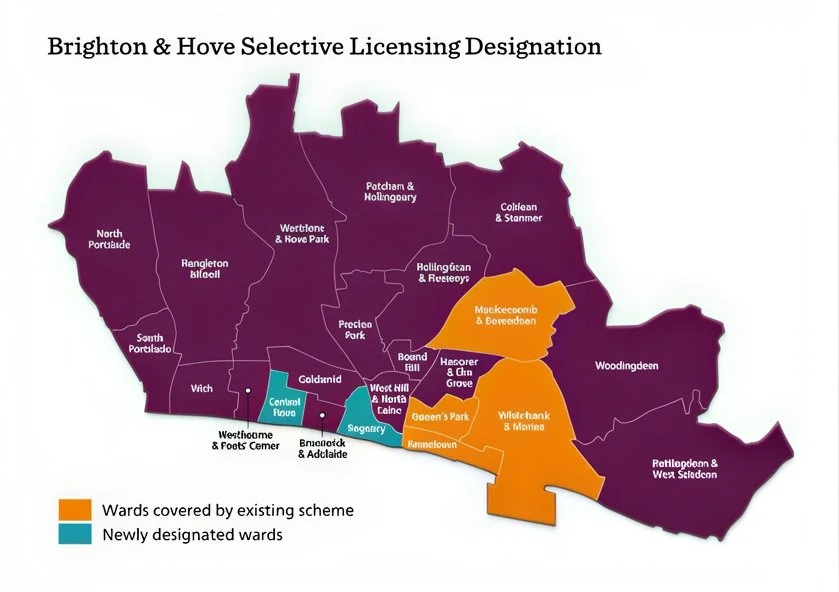
The council's designation map showing the existing selective licensing wards in orange and the two newly designated wards, Regency and Central Hove, in teal
Brighton News
Two more Brighton and Hove wards are being brought into the council's selective licensing scheme, meaning thousands more private landlords will soon need a licence to let their properties.
Brighton and Hove City Council has published designation notices for the Regency and Central Hove wards, which will join the scheme from October 2026. The council says it is expanding the programme after seeing a positive impact in the first four wards where it launched.
Selective licensing sets legal standards for private rented homes. It requires landlords to meet firm rules on gas, electricity and fire safety, keep properties in good condition, and deal promptly with problems such as damp or disrepair. The council says it also gives tenants more security and gives landlords a clear understanding of what the law requires, helping them avoid fines or enforcement action later.
The scheme first launched in 2024 across four wards: Kemptown, Moulsecoomb and Bevendean, Queens Park, and Whitehawk and Brighton Marina. Following an interim review of its impact, the council is now rolling it out further as part of a phased plan that will eventually cover 13 areas of the city.
Councillor Gill Williams, Cabinet Member for Housing at Brighton and Hove City Council, said the aim of the scheme is to improve the conditions and management of the city's expanding private rental sector.
With nearly a third of households in Brighton and Hove privately rented, we know this has the potential to have a huge impact on people, the quality of their housing and the security they feel
Councillor Gill Williams, Cabinet Member for Housing
What it means for landlords in Regency and Central Hove
Landlords in the Regency and Central Hove wards will need to apply for a selective licence if they rent to one occupier, two occupiers, or a family. The council estimates that up to 7,274 properties across the two wards will require a licence.
Council staff have already contacted landlords and letting agents in the two wards to explain the scheme, and the council says support is available to guide people through the process. Applications for licences will open online on 20 October 2026, the date the designation comes into force. The scheme will run for five years, until 19 October 2031, unless the council revokes it sooner.
Some tenancies are exempt, including certain houses in multiple occupation that already fall under the council's separate HMO licensing schemes, homes let by registered social landlords, and a small number of other categories set out in national regulations.
Why licensing rather than enforcement
When the scheme was first consulted on, some landlords asked why the council could not simply use its existing enforcement powers. In its published consultation responses, the council explained that enforcement is a slow, reactive process that only deals with one property at a time and does nothing about wider problems across the rented sector.
Licensing, the council said, is a quicker and more proactive route. It allows officers to inspect a property without first receiving a complaint, and landlords must meet the licence conditions or face action. Landlords who are accredited and already meet national standards of good practice are offered a reduced fee.
On the common question of short term lets, the council confirmed that most Airbnb and party house lettings are classed as holiday lets and fall outside selective licensing, though the scheme can apply where a short term let is not a genuine holiday let. It also addressed concerns that licensing could push up rents or lead to homelessness, saying the fee is spread over five years and is tax deductible, and that it does not expect the scheme to increase homelessness.
The penalties for not having a licence
Once the scheme comes into force, operating a licensable property without a licence becomes a criminal offence. On conviction, a landlord can face an unlimited fine. As an alternative to prosecution, the council can impose a financial penalty of up to £40,000 and can take over management of an unlicensed property.
Tenants and the council can also apply for a Rent Repayment Order, which can require a landlord to pay back up to 24 months of rent, Housing Benefit or Universal Credit. On top of that, a landlord cannot serve a Section 21 eviction notice on tenants of a property that should be licensed but is not.
It really is a win-win. It has been great to see the impact it has already had and I look forward to seeing that positive impact being felt across the city as it is rolled out further
Councillor Gill Williams, Cabinet Member for Housing
Part of a wider shift for renters
The expansion comes alongside wider changes to renting law. The Renters' Rights Act came in on 1 May 2026, giving councils more powers to investigate landlords and enforce compliance, with higher fines and penalties for breaches. In May the council introduced a new Private Sector Housing Enforcement Policy to reflect the national changes.
Councillor Williams said the scheme is also about supporting responsible landlords, describing the overwhelming majority as people who want to provide secure, high quality housing to their tenants. A full review of the impact of the original scheme is scheduled for 2029.
Landlords, agents and tenants who want to know whether a property is affected can contact the council's Private Sector Housing team by emailing psh@brighton-hove.gov.uk or calling 01273 293 156.