
Brighton's Royal Sussex County Hospital Opens New Helipad and Lays Foundation Stone for £250 Million Cancer Centre
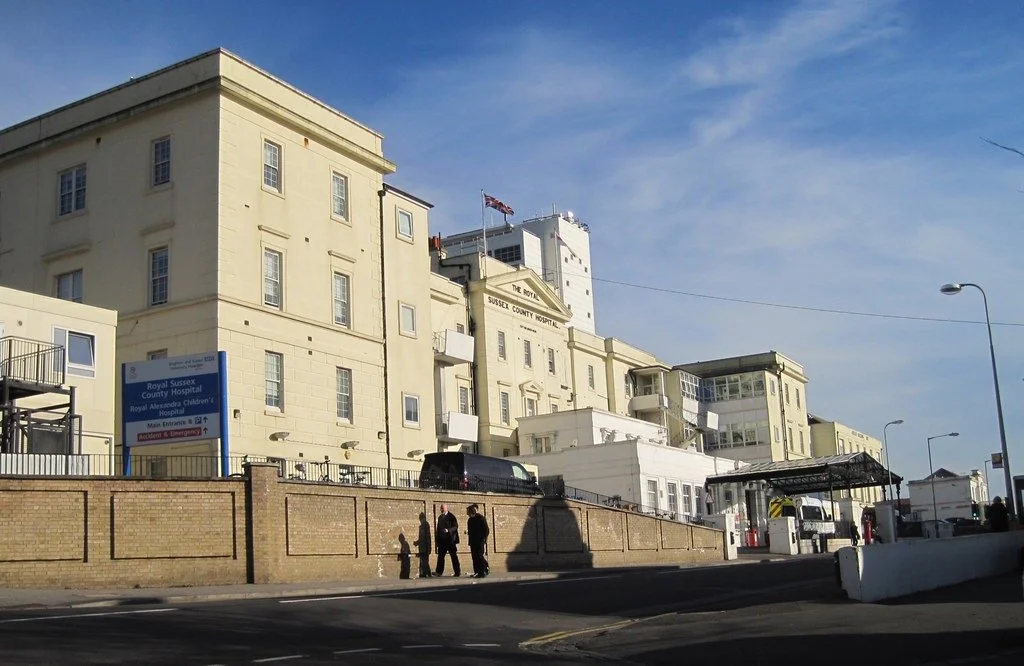
The Royal Sussex County Hospital on Eastern Road in Brighton. The site is undergoing an £860 million modernisation programme, the largest infrastructure investment in the city's history. Photo: Nigel Chadwick via Geograph, Creative Commons licence.
Two of the most significant moments in the decade-long transformation of Brighton's main hospital took place on the same day last Friday. On 22 May 2026, University Hospitals Sussex NHS Foundation Trust officially opened a brand new emergency helipad at the Royal Sussex County Hospital and laid the foundation stone for a new £250 million cancer centre on the same site. Both ceremonies happened within hours of each other. Both mark turning points in a project that has been reshaping one of Brighton's most important institutions for over ten years.
The total cost of the full modernisation programme for the Royal Sussex County Hospital now stands at £860 million. It is the largest infrastructure investment in Brighton and Hove's history and one of the most significant hospital rebuilding programmes anywhere in England.
The New Helipad
The Royal Sussex County Hospital is the major trauma centre for the entire Sussex region. That means when someone is involved in a serious road accident, a severe fall or any life-threatening incident across Sussex, the Royal Sussex is where they are taken. For many of those patients, every minute matters. Until last Friday, the hospital did not have a dedicated helipad on site.
The new emergency helipad, which was officially opened at the ceremony on 22 May, changes that. It sits at the highest point of the hospital site and gives air ambulances direct access to the trauma centre below. Andy Heeps, chief executive of University Hospitals Sussex NHS Foundation Trust, described it as a key piece of infrastructure that underpins the hospital's status as the region's major trauma centre.
The first patient to arrive by helicopter on the new helipad did so on the day of the opening ceremony, making it immediately operational from the moment it was declared open. For emergency services across Sussex, the new helipad represents a significant improvement in the speed at which critically injured patients can receive specialist care.
The Foundation Stone for the New Cancer Centre
The second ceremony on 22 May was the laying of the foundation stone for the new Sussex Cancer Centre. The new centre, which will cost £250 million, is being built on the site of the now-demolished Barry Building — the oldest building in the NHS that was still being used for acute patient care when it was finally taken out of service.
The new Sussex Cancer Centre will have twice as many beds as the current cancer facilities at the Royal Sussex. It will serve a population of approximately 1.8 million people across Sussex and beyond. Cancer treatment in Brighton has historically been carried out in outdated facilities in Bristol Gate, a situation that clinical staff have long described as far below the standard that patients deserve. The new centre changes that entirely.
Bill Shay, a 70-year-old cancer survivor from the Kemptown area of Brighton who has been receiving treatment at the hospital since 2015, was chosen to lay the foundation stone at the ceremony. He used the occasion to thank the staff who had treated him and to pay tribute to those still working in the outdated cancer facilities. His presence at the ceremony made clear what the new centre is ultimately about: the patients.
What Andy Heeps Said
University Hospitals Sussex chief executive Andy Heeps spoke at both ceremonies on 22 May. He said the two milestones literally could not be further apart physically — one is below ground and the other is the highest point of any of the trust's hospitals — but that both are connected by the same mission.
"What connects them though is they are both at the heart of our mission to provide all our patients with excellent care — and do so on a scale that only a trust of our size can manage," Heeps said.
"The emergency helipad is a key piece of infrastructure that underpins our status as the region's major trauma centre. And the new Sussex Cancer Centre will provide genuinely transformative care for one of the largest patient populations in the country."
The Full Story of the £860 Million Rebuild
The Royal Sussex County Hospital sits on Eastern Road in Brighton, overlooking the city and the sea. It has been Brighton's main hospital for over 200 years. The buildings that were in use until relatively recently included some of the oldest still being used for acute patient care anywhere in the NHS — structures that predate Florence Nightingale's career in nursing.
The case for rebuilding the hospital was made for decades. The government first approved funding for a major redevelopment in 2014 when Chancellor George Osborne visited Brighton to announce the investment. At that point the budget was £420 million. The project has expanded significantly since then and the total programme now stands at £860 million.
The rebuild has taken place in stages across the entire hospital site while clinical services have remained operational throughout. The first major milestone came in 2022 when the new Millennium Wing opened, bringing modern ward facilities to replace some of the hospital's oldest buildings. The wing has more than 40 wards and departments, a major trauma centre, new teaching facilities and a critical care unit. The new entrance is more than 20 times the size of the existing reception area that it replaced.
In February 2026, the new Acute Medical Unit opened on level 5 of the Millennium Wing. Sister Gladys Gonsalves, the longest-serving nurse in the hospital's acute assessment service with 27 years of service, cut the ribbon to officially open the unit. The new AMU is designed to care for around 500 patients every week, served by 12 acute medical consultants, 30 other doctors, more than 110 nurses and healthcare assistants and a range of therapists, pharmacists and other support staff. It also includes a new Medical Same Day Emergency Care unit that for the first time extends 24-hour access to specialist care for patients who do not need an overnight stay.
The A&E department at the Royal Sussex was built in 1970 to handle between 20,000 and 30,000 patients a year. It now sees more than 100,000 patients annually. The new facilities are built to handle that level of demand sustainably for the decades ahead.
What the New Cancer Centre Means for Brighton
Cancer treatment is one of the most significant areas of the hospital's work. The Sussex Cancer Centre will serve a population of 1.8 million people, making it one of the largest cancer treatment facilities built anywhere in England in recent years. It will occupy the site of the Barry Building, which was demolished as part of the earlier stages of the hospital's modernisation.
The new centre will have twice the bed capacity of the current facilities, modern diagnostic equipment, dedicated chemotherapy suites, radiotherapy facilities and specialist cancer nursing teams in a purpose-built environment. For patients in Brighton and across Sussex, it represents the end of receiving cancer treatment in buildings that were never designed for that purpose.
Construction of the cancer centre is now underway following the foundation stone ceremony on 22 May. A completion date has not yet been publicly confirmed but the project forms the final major phase of the £860 million modernisation programme.
What This Means for Brighton and Hove
The Royal Sussex County Hospital is the biggest employer in Brighton and one of the most important public institutions in the city. The transformation now underway affects every person in Brighton and Hove, whether they are a patient, a family member of a patient, a member of staff or simply a resident who knows that a well-functioning hospital is central to the health of the whole city.
The new helipad means faster access to trauma care for the most seriously injured patients across Sussex. The new cancer centre means better conditions and better outcomes for thousands of cancer patients who currently receive treatment in facilities that are far below modern standards. The new Acute Medical Unit means more efficient and more effective emergency assessment for the more than 100,000 people who arrive at the Royal Sussex each year needing urgent care.
For a city of 280,000 people, the investment being made in the Royal Sussex County Hospital is genuinely transformative. The building work is visible across Brighton's eastern skyline and the results of that work are already being felt by the patients, nurses and doctors who use the hospital every day.
University Hospitals Sussex NHS Foundation Trust runs seven hospitals across Sussex including the Royal Sussex County Hospital in Brighton, the Princess Royal Hospital in Haywards Heath and the Worthing Hospital. It is one of the largest NHS trusts in England by patient numbers.
For more on what is happening in Brighton right now read our Brighton Travel Guide 2026, our Brighton Events Guide 2026 and our Brighton Hidden Gems Guide.
Source: University Hospitals Sussex NHS Foundation Trust. For more information on the Royal Sussex County Hospital modernisation programme visit uhsussex.nhs.uk
