
From Belfast to Banjul: University of Brighton's Football 4 Peace Marks 25 Years Uniting Communities Across the World
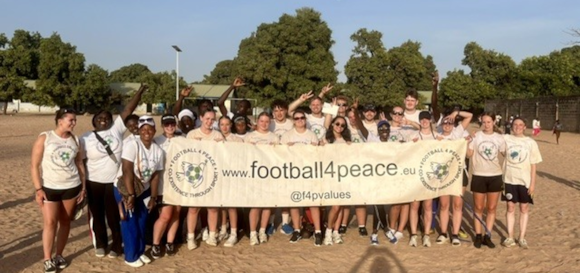
University of Brighton staff and students are currently working with young people in The Gambia as Football 4 Peace celebrates its 25th year. Photo: University of Brighton
As the FIFA World Cup kicks off around the world, a University of Brighton programme is marking 25 years of using football to unite communities across some of the world's most divided societies
Football 4 Peace was founded in 2001 by University of Brighton academics Professor John Sugden and Dr Gary Stidder, initially as a way of bringing together Israeli and Palestinian communities in the Galilee region of Israel. Twenty-five years on, the programme has reached more than 8,000 young people and 600 coaches across four continents, from The Gambia and Colombia to Northern Ireland, South Korea and South Africa.
The programme is built around a values-based coaching methodology founded on five core principles: equity, inclusion, respect, trust and responsibility. Its first cohort brought together Jewish and Arab children to play football together. The model has since been refined through more than two decades of academic research, field evaluation and community partnership across the globe.
In its 25th year, University of Brighton staff and student coaches are currently working alongside local coaches and young people from diverse ethnic and community backgrounds in The Gambia, demonstrating the sport's capacity to transcend division in one of West Africa's most diverse nations.
What the programme does
Dr Gary Stidder, Principal Lecturer in Physical Education at the University of Brighton and co-founder of Football 4 Peace, said the key emphasis of the values-based model is the teaching and practical application of core values in socially fractured societies. He said the approach is designed to be flexible and can be used to help resolve conflict, promote community reconciliation, develop inter-personal skills, build cultural bridges and develop positive relationships among young people, ultimately with the aim of promoting an appreciation for diversity in society.
Dr Stidder added that the programme's footprints around the world in countries such as South Korea, Colombia, Northern Ireland and The Gambia, involving thousands of children and community sports leaders as well as University of Brighton students, are testament to its success.
In The Gambia, Football 4 Peace assigns leadership roles to young people from previously marginalised ethnic groups and works across community boundaries. The programme has demonstrated that sport can be a catalyst for social change not just on the pitch, but within communities, families and institutions.
Clara Foster, a first-year Physical Education student at the University of Brighton who recently returned from The Gambia, said the connections formed with the children were especially precious and rewarding, as they allowed the group to gain a deeper understanding of their lives, culture and day-to-day experiences. She said the programme brings everyone together not only physically but emotionally, as participants support, encourage and collaborate with one another through every experience and challenge along the way, creating an incredibly strong sense of belonging and relationships that can genuinely last a lifetime.
A lasting impact
James Clarke, a member of one of the earliest cohorts to Israel in 2003, is now the Lead Physical Education Tutor across the Swale Academies Trust. He said that on the first day, the young players from different communities were not even able to look at each other, let alone communicate and play as a team. By the end of the week they were teammates, working together, overcoming problems, communicating, smiling and valuing each other as people. He said that was extremely powerful and an insight into how powerful football could be, and that he has carried that into his teaching career ever since.
The programme has shaped policy as well as practice. It was officially recognised by Israel's Ministry of Culture and Sport in 2019 and has contributed to debate at NATO on conflict prevention, cultural relations and the role of sport in building resilient societies. Through partnerships with the British Council, The Football Association and the German Sports University in Cologne, Football 4 Peace offers a replicable, evidence-based model for peacebuilding through sport.
Its mentoring and ripple effect structure ensures that skills, values and coaching methodology are transferred to local leaders and institutions, creating sustainable change long after University of Brighton staff and students have returned home.
More information about Football 4 Peace is available at football4peace.eu. For more University of Brighton news follow ImJustBrighton and read our coverage of the University of Brighton podiatry awards 2026.
