
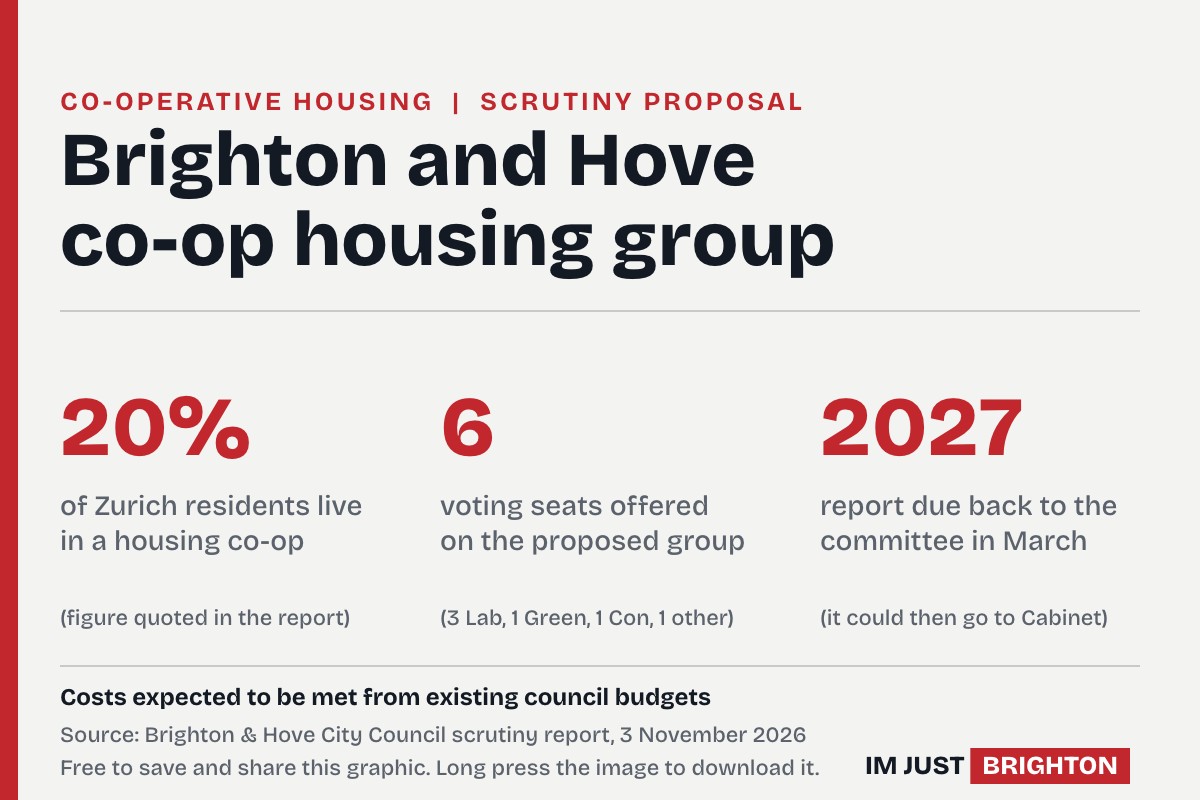
Brighton and Hove City Council's Place Overview and Scrutiny Committee was asked on 3 November 2026 to set up a task and finish group on co-operative housing. The group would look at whether co-ops could help with rents, housing supply and insecurity in the city, and would report back to the committee in March 2027. The proposal is in a scoping report on the committee's agenda, which is on the council's meeting page.
The idea comes from a Notice of Motion submitted to full Council on 29 January 2026, which asked the committee to explore how the council could support and expand the co-operative housing sector in the city. The same committee meeting also covered the council's housing safety update.
What the report means by co-operative housing
Residents in control. The report describes co-operative housing as a model where residents collectively take part in owning, managing or governing their homes through a democratically run organisation. It says there are two main types. Some co-ops own and manage existing homes with several occupants. Others develop new homes through community-led ownership, bringing people together to get land, funding and construction.
A small sector. The report says co-operative housing has historically been seen as a niche, small-scale form of housing in the UK. It points to Zurich, where it says 20 percent of residents live in a co-op, often with shops, nurseries, restaurants and workspaces included. In Brighton and Hove, it says the sector is relatively small and fragmented despite established co-ops and interest from residents and community groups.
Why the committee is looking at it
The housing pressure. The report lists high private sector rents, growing demand for social and affordable housing, limited land and financial pressures as the city's main housing challenges. It says three in four new British homes are built by for-profit developers, and that councils under financial pressure tend to accept the highest price when selling land, which is usually a commercial developer rather than a community group.
Barriers. The report says barriers appear to include a lack of coordination across the sector, limited awareness, lengthy and complex legal processes, difficulty finding suitable properties, and concerns that some existing groups may be hard for new members to join.
What co-ops could offer, according to the report
Security and rents. The report says co-op homes can be more secure because there is no landlord who might sell, so tenants are not exposed to a Section 21 notice. It says rents can be kept lower because the housing is run for community benefit rather than developer profit, with surpluses reinvested in the homes.
Younger residents. The report says high rents and house prices can push younger people out of Brighton and Hove, and suggests co-ops could help keep them by offering lower-cost, more secure homes. It says existing properties, including houses in multiple occupation, could be adapted for co-operative use without new development.
Housing register. The report adds that the council could link co-op organisations with people on the housing register, which could reduce pressure on housing services.
Buying existing homes. The report says changes to landlord licensing, including HMO licensing, may have raised costs for some landlords and could lead properties to leave the private rented sector. It suggests co-ops could buy and manage some of them, with the council helping to bring groups together. It says this would be cheaper than building new developments.
Funding and law. The report says community groups can often reach more funding than councils. It says the government is working with the Confederation of Co-operative Housing and others on legislation for a co-operative form of tenure, changes to the Localism Act and low-cost capital finance for co-ops. It also points to Liverpool, which has adopted policies to unlock vacant council land, brownfield sites and empty properties for community groups.
Who the group could hear from
Local co-ops. The report suggests witnesses including the Two Piers, Brighton Rock Co-operative and Bunker Housing Co-op schemes, a community land trust and community groups interested in developing co-ops.
Elsewhere. It also names Allgemeine Baugenossenschaft Zürich, Coin Street and Marmalade Lane in Cambridge as examples, and suggests hearing from the councils of Liverpool, Bristol and Lewisham, sector experts, academics and representatives of the Ministry of Housing, Communities and Local Government.
How the group would work
Membership. The terms of reference describe an informal group that reports to the committee and is chaired by the committee's chair. Groups on the council would be offered six voting places: three Labour, one Green, one Conservative and one Brighton and Hove Independents or independent member. Anyone with an interest could be co-opted as a non-voting member.
Timeline and cost. The group's report would go to the committee in March 2027, and the committee could then refer its recommendations to Cabinet or partners. The report says no financial implications are expected, as any costs would be met from existing service budgets.
The decision. The committee was asked to agree to set up the group and approve its terms of reference, membership and duration. Members could amend the terms of reference if they chose.


Comments
No comments yet. Start the conversation.