Brighton Council Bans Gambling and Fossil Fuel Adverts on Its Advertising Sites
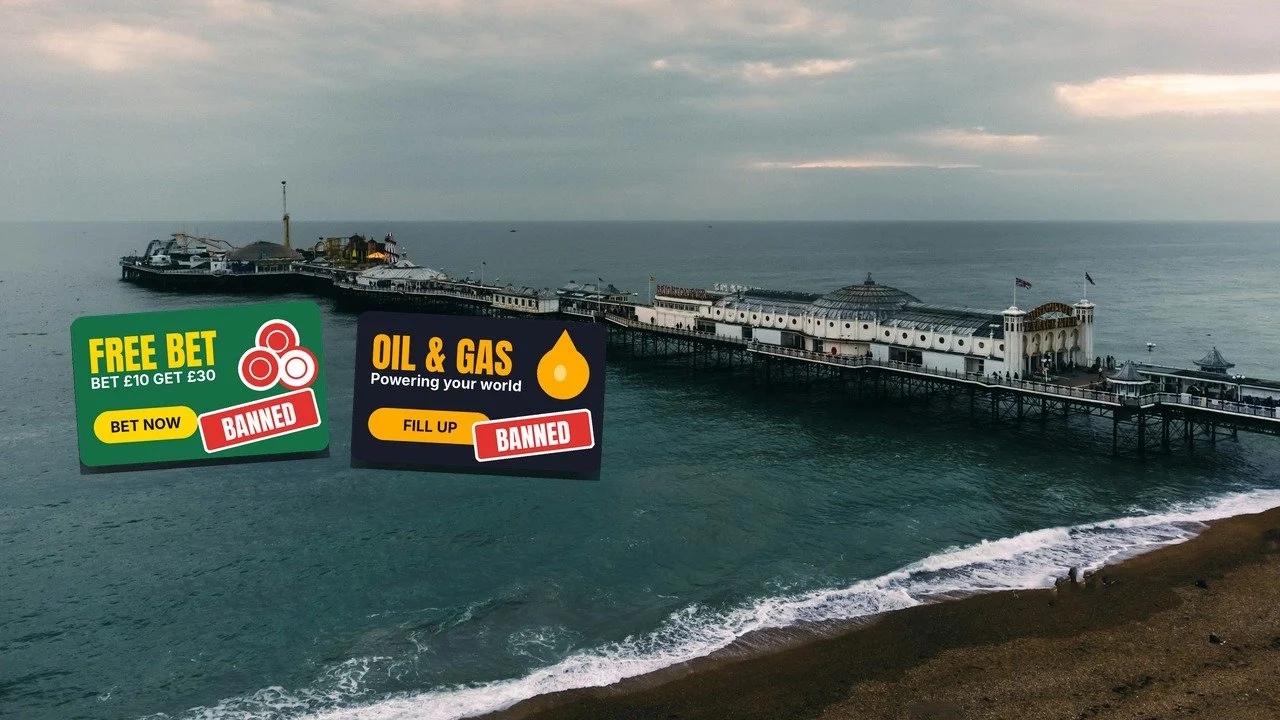
Brighton Palace Pier from above (Photo: Neeraj Pramanik via Unsplash)

Brighton & Hove City Council’s Cabinet has approved a new Advertising and Sponsorship Policy that bans gambling adverts and adverts from fossil fuel production companies on council-owned and council-managed advertising sites. The council’s published decision list shows all four recommendations in the report were approved at the meeting on 15 October 2026.
Cabinet also agreed that the council will join the Coalition to End Gambling Ads and run a pilot on three to five low-risk sites for wraps, banners and hoardings. The decision takes effect on 23 October unless it is called in.
Source: Brighton & Hove City Council, Cabinet decision list, 15 October 2026
What is banned outright

The policy covers adverts, sponsorship and brand activations on assets the council owns or manages. Under the heading of absolute prohibitions it lists political organisations and lobbying groups, tobacco and nicotine products, addictive substances, weapons, payday loans and exploitative financial products, pornography and sexual services, gambling, and companies involved in fossil fuel production.
Two of those have narrow exceptions written in. Tobacco and nicotine adverts can be accepted only as part of a stop smoking campaign, where quitting support is central and the product is not owned or part-owned by the tobacco industry. Sexual health content is allowed if the NHS endorses it.
Separately, the policy says the council will not accept content that is discriminatory or offensive, promotes illegal, violent or socially harmful behaviour, or tries to influence council decisions or procurement.
Which council advertising sites are covered
The policy defines advertising as paid placement of content on council-controlled assets, including websites, social media, publications, buildings, vehicles, highways, the seafront, hoardings and digital screens. The report lists freestanding digital advertising units, large-format advertising, temporary building wraps or banners, brand activations and partnerships. It also names smaller public-realm spaces such as bicycle parking, guardrails and wayfinding signs.
What is decided case by case
Four categories are not banned but get extra checks, and the council can set conditions such as placement limits, age-gating and content controls. They are alcohol (only where responsible drinking is clearly highlighted), financial services (only where products are not exploitative), food and drink brands, and products, services or brands with particularly harmful environmental impacts.
For food and drink, the policy uses the UK Nutrient Profiling Model to decide whether a product counts as high in fat, salt or sugar (HFSS). The rules work on the product, not the brand, so a company can still advertise a healthier product.
The council says this folds in the way it already treats HFSS adverts. The policy says the HFSS controls apply to outdoor advertising such as bus shelters, hoardings and digital panels, council premises open to the public, and council-run or council-supported events.
Why gambling adverts are banned
The report says the ban fits the council’s commitment to putting residents’ wellbeing first and protecting children and vulnerable adults from harm. Locally, the council’s Health Counts 2024 survey found more than one in five adults in Brighton and Hove say they gamble, even if only occasionally, and nearly a fifth of those who gamble experience some form of harm. We covered those figures in our report on the council’s World Cup gambling harm campaign.
Cabinet also agreed the council will join the Coalition to End Gambling Ads (CEGA). The report says membership has no fee, almost 20 other councils across the UK are already members, and the council can decide how involved to be. As a member it could share campaign content, contribute to events or political roundtables, or develop its own campaigns.
CEGA is run by director Will Prochaska and calls for an end to gambling advertising, sponsorship and promotion. Councils already in it include Bristol, Sheffield, Hackney, Islington, Southampton and Blackpool, according to coverage of Liverpool joining in July 2026. East Suffolk Council says councils can only restrict adverts in the spaces they control, so joining adds weight to calls for national rules.
Gambling support in Brighton and Hove
- Breakeven offers free, confidential support for people struggling with gambling and for those affected by someone else’s gambling: 01273 833 722 or breakeven.org.uk.
- GamCare runs the National Gambling Helpline, open 24 hours a day, on 0808 8020 133.
Why fossil fuel production adverts are banned
The policy describes the banned category as exploration, extraction, production, refining or promotion of fossil fuels, including coal, oil, gas, tar sands and unconventional hydrocarbon extraction. The report says the policy will also assess the environmental impact of what is being advertised, including greenhouse gas emissions, energy use and waste.
The banned list does not name airlines, petrol cars or fast fashion. Products, services or brands with “particularly harmful environmental impacts” are in the case-by-case group instead, so the council can consider them one at a time.
The ban was questioned in the council papers. Councillor Meadows asked why the council will refuse fossil fuel production advertisers and whether that is a political decision. The papers do not include the answer.
How Brighton compares with Bristol and Sheffield
Other councils have gone further on some categories. The council’s own papers point to Bristol and, in the 2024 motion, to Sheffield.
Sheffield’s committee report said revenue could fall, but that evidence from other councils with similar bans suggests little impact because brands tend to move to spaces outside council control.
Why the council wants advertising income
The report says a recent asset audit found the city has good advertising fundamentals: a recognised national and international identity, a major visitor economy, a prominent seafront, strong retail and hospitality, a busy events programme, and a large student population and younger resident profile. It says those opportunities have not been maximised because decisions have been fragmented.
The council wants the income to contribute to its Medium Term Financial Strategy. The report is clear that the policy sets controls and does not itself guarantee income, and it gives no figure.
Who decides, and what happens to a bad advert

Every proposal gets proportionate checks, which can include a financial appraisal, legal review and a reputational assessment. Approval depends on risk. Routine placements can be signed off by the relevant Head of Service. New partners, higher-value deals and restricted categories need a Director. Novel or sensitive proposals go to a Director-level decision, with the Cabinet Member involved where appropriate.
A written legal agreement is mandatory before any advert or sponsorship starts. The council can remove, suspend or end an arrangement that later becomes unacceptable, including after complaints, regulatory action or a change in what the partner does. The policy will be reviewed every year, or sooner if the law, public health or priorities change.
Any substantive departure from the policy has to go back to Cabinet. Cabinet also gave the Director for People and Innovation power to make minor changes, in consultation with the relevant Cabinet Member, as long as they do not change the policy’s purpose or the agreed prohibitions.
What the policy does not cover
What it means for advertisers and sponsors
Every advert has to be legal, decent, honest and truthful, and comply with the Advertising Standards Authority (ASA) and the UK advertising code (the CAP Code). The council keeps final approval over any use of its name, logo and branding, and says accepting an advert does not mean it endorses the product or the advertiser.
The policy lets the council publish a clear offer such as an asset list, media pack or rate card, run time-limited pilots, and develop naming rights deals where they deliver significant public benefit. It says officers and outside organisations should contact the council’s Marketing and Communications team for advice, at news@brighton-hove.gov.uk or on 01273 29 00 00.
What it means for residents
The council’s equality impact assessment says children and young people should benefit most from the limits on gambling, addictive substances, exploitative finance and HFSS adverts. It notes Brighton and Hove has a young adult population: the 2025 Joint Strategic Needs Assessment estimates 27% of residents are aged 19 to 33, compared with 17% in the South East and 19% in England.
The assessment also flags risks. Digital screens with flashing or moving content, bright light and sound could create barriers for disabled people, and age-gating rules could be applied inconsistently. It says the council will apply accessible creative standards and control flashing, rapid movement and brightness.
A central log of decisions and complaints will be reviewed at least every quarter in the first year, then at the annual review of the policy.
Questions councillors submitted
Three councillors submitted written questions on the policy for the meeting, according to the council papers. The papers do not include the answers.
The advert in Councillor McNair’s question was the council’s own. In June 2026 the ASA ruled against a Brighton and Hove City Council digital poster that showed a wood-burning stove with the line “The cosy killer” and a claim about particle pollution near four primary schools. The regulator said it had not seen evidence for the direct link the ad implied, according to law firm Lewis Silkin. Councillor Tim Rowkins told Brighton and Hove News the ruling was against one graphic, not the campaign as a whole.
How it got here
In October 2024 the Green Group put a motion to full Council asking for an ethical advertising policy. It noted that the council already restricts HFSS adverts and that Sheffield had gone further with bans covering carbon-intensive products and gambling. A Labour amendment asked officers to report on how an ethical advertising policy could work, including any loss of income. You can read the motion and the amendment on the council website.
The Cabinet report does not mention that motion. It says the draft policy came from talks with other councils and lead members, and was shaped by input from communications, public health, culture and events, property, planning, licensing and operational services.
Brighton council advertising policy: your questions answered
What is the Brighton and Hove City Council advertising policy?
It is the Advertising and Sponsorship Policy that Cabinet approved on 15 October 2026. It sets the rules for advertising, sponsorship and brand activations on council-owned and council-managed assets.
Are gambling adverts banned in Brighton?
They are banned on council-owned and council-managed advertising assets. The policy does not regulate advertising on privately owned assets, and existing concession contracts are excluded until renewed or varied.
Are fossil fuel adverts banned in Brighton?
Adverts from companies involved in fossil fuel production are banned on council assets. Other products with particularly harmful environmental impacts are decided case by case.
Is alcohol advertising banned?
No. Alcohol is a restricted category, considered case by case and only where responsible drinking is clearly highlighted.
When does the policy start?
The decision takes effect at close of business on 23 October 2026 unless it is called in. The council plans a pilot on three to five low-risk sites before the end of 2026.
Does the ban cover bus shelters?
Advertising under existing concession contracts, such as bus shelter advertising, is excluded until those contracts are renewed or varied.
What is the Coalition to End Gambling Ads?
CEGA is a cross-sector alliance of councils, public health bodies and charities that calls for an end to gambling advertising, sponsorship and promotion. Brighton and Hove City Council has agreed to join, at no cost.
What does HFSS mean?
It stands for high in fat, salt or sugar. The council uses the UK Nutrient Profiling Model to decide whether a product is HFSS, and rejects adverts for HFSS products on its sites.
Will the council make money from adverts?
It hopes so, but the report says the policy does not guarantee income and gives no figure.
Where can I complain about an advert?
The council says it will log and review complaints about adverts on its assets. Complaints about the content of adverts in general can also go to the Advertising Standards Authority.
What we still do not know
The papers do not say which sites will be in the pilot or how much income the council expects. They do not say when the CEGA membership will be completed, or how the council will apply the policy to contracts that already exist. We have also not seen the answers to the councillors’ questions.
What happens next
More is under Brighton and Hove City Council, gambling harm, climate action and cabinet decision on ImJustBrighton.
Sources
- Brighton & Hove City Council: Cabinet decision list, 15 October 2026
- Brighton & Hove City Council: decision page, item 57, Advertising and Sponsorship
- Cabinet report: Advertising and Sponsorship
- Appendix 1: Advertising and Sponsorship Policy
- Appendix 2: Equality Impact Assessment
- Cabinet papers: written questions from members, 15 October 2026
- Cabinet agenda and documents, 15 October 2026
- Council notice of motion, 24 October 2024: Restricting unethical and carbon intensive advertising
- ITV News: Bristol councillors vote to end high-carbon advertising on council-owned sites
- The Star: Sheffield ban on adverts for unhealthy food, gambling, smoking and fossil fuels
- SBC News: Liverpool City Council joins CEGA
- Bristol24/7: Bristol joins councils across the country to say no to gambling ads
- East Suffolk Council: Council joins call to end gambling advertising
- Lewis Silkin: the ASA ruling on Brighton council
- Brighton and Hove News: council wood burning advert banned
Read more from ImJustBrighton
Odds Are They Win: Brighton and Hove Backs New Gambling Campaign During the World Cup
Brighton’s Kingswest Building Applies for Giant Seafront Advertising Shroud
Black Rock Brighton: Cabinet Approves Preferred Bidder for Temporary Seafront Use