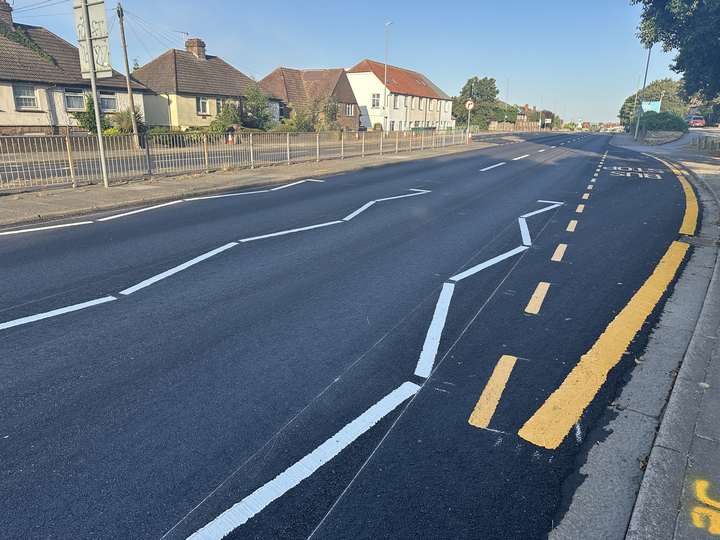
The Department for Transport has unlocked just over £1.4 million for Brighton & Hove City Council to spend on resurfacing roads, repairing potholes and other defects, and improving pavements. The council announced the award in a news release on 23 October.
It says the money is already built into this year’s maintenance plan. The award recognises the work already being done and the council publishing its Local Highways Maintenance Transparency Report, which sets out the condition of the city’s roads, its strategy and its plans for 2026/27. We have read the full report, and the figures are below. The wider programme was covered in 850 Miles of South East Roads Due for Resurfacing: Brighton Plans.
What the council says about the award

“This is great news and testament to the hard work being done by the team.
“Residents are seeing a visible improvement in the condition of our roads, with treatment, resurfacing and repair programmes taking place across the city.
“We’ve invested in better technology, gathered more detailed information and developed a far clearer understanding of the condition of our road network. That data has given us a more honest picture of what needs fixing and where investment will have the greatest impact.
“We welcome the recognition by the government of our achievements in making our city roads and path better. We’re using this funding to make journeys smoother, safer and more accessible for everyone.”
Councillor Trevor Muten, Cabinet member for Transport and City Infrastructure
Where the £8.8 million is going
The council is spending £8.8 million in 2026/27 on making roads and pavements better, safer and more accessible. Its February announcement says that is money granted by the Department for Transport, and the plan went to Cabinet on 12 February. The full Cabinet report is online.
Roads. Almost £4 million on improving roads.
Potholes and repairs. £2.2 million on fixing immediate problems such as potholes and other road repairs.
Pavements. Over £1 million on making pavements better.
Accessibility. £200,000 on improvements including dropped kerbs, on top of the pavements being improved through planned maintenance and ongoing projects.
Safer streets. £360,000 for safer roads and junctions, and school streets schemes.
Major projects. More than £2 million on helping to deliver major projects.
The council says that by 2027/28 it intends to double the funding allocated to preventative maintenance across the network, to protect roads before serious deterioration occurs. It also says the Department for Transport has now confirmed what it will receive for the next four years, rather than year by year, which lets it plan ahead. The February announcement adds £3.3 million from the Local Authority Bus Grant and £900,000 of Active Travel funding.
How much the council spends on highways
The transparency report puts total highways maintenance spending at £15,155,654 in 2024 to 25 and £21,878,152 in 2025 to 26. It projects £26,798,871 for 2026 to 27.
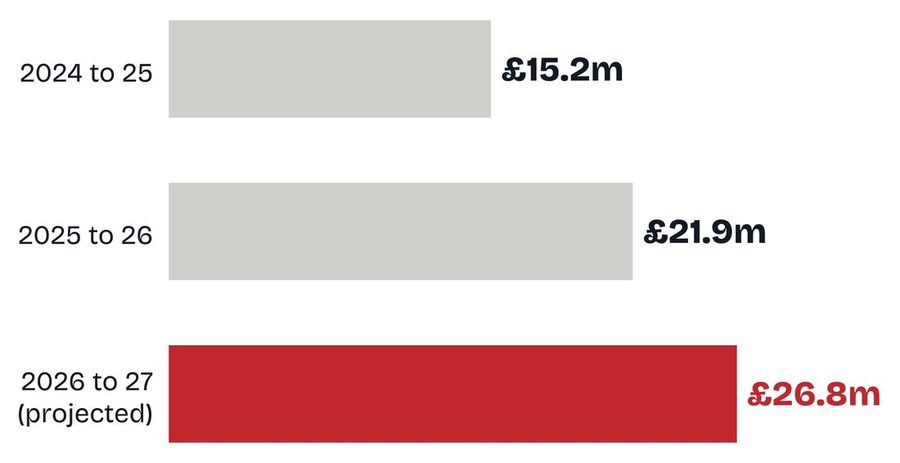
Money from the Department for Transport and the UK Government was £8,272,500, then £11,840,036, and is projected at £15,452,836 for 2026 to 27. The rest comes from the council or third parties: £6,883,155, then £10,038,115, and a projected £11,346,035.
Of the projected 2026 to 27 total, the report lists £8,098,426 for carriageways, £2,239,878 for footways, £6,340,220 for structures such as bridges or tunnels, £3,875,659 for street lighting and £332,500 for drainage. Another £5,912,188 is listed under other assets.
What condition the roads are in
Councils grade roads green, amber or red. Green means the road is in good condition. Amber means it may need maintenance soon. Red means it is in poor condition and should be considered for maintenance. The report gives the share of Brighton & Hove roads graded red for the last three years.
A roads. 6% red in 2023, 18% in 2024 and 14% in 2025. In 2025, 33% were amber and 54% green.
B and C roads. 4% red in 2023, 15% in 2024 and 12% in 2025. In 2025, 31% were amber and 57% green.
Unclassified (U) roads. 11% red in 2023, then 8% in 2024 and 8% in 2025.
The council says the jump in red roads from 2024 reflects a change in how condition is measured, not a big drop in the roads themselves. It used to rely on SCANNER surveys. In 2023 to 2024 it moved to Annual Engineers Inspections, where qualified engineers assess the full network and identify treatments for practical lengths of road, usually between junctions. From 2026 to 2027 the Department for Transport will bring in the PAS 2161 standard, which sorts roads into five categories instead of three, so the council expects further shifts in the figures before a new baseline is set.
Why the city’s roads are hard to keep up
The report points to historic underinvestment and an ageing network. The city manages around 150km of concrete roads, many near the end of their design life. It also lists hotter and wetter extremes, salt-laden coastal air, the highest bus use outside London, and the UK’s largest population of elm trees, whose roots can damage pavements, kerbs and roads.
The network the council looks after is large: 620km of roads, 1,159km of footways and 49km of cycle ways, plus 22,489 street lighting assets, 6,502 traffic signal assets, 159 highway structures and 25,479 drainage assets.
How potholes are handled
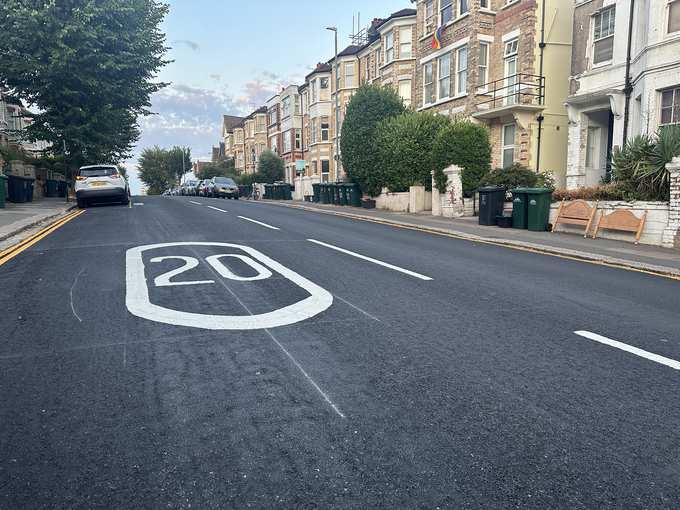
The council does not define a pothole by size alone. It inspects a road defect once there is an abrupt level difference of 40mm and a pavement defect at 20mm. Inspectors then judge the risk, looking at traffic levels, the location and how likely it is to cause an accident. Repairs can be due within 2 hours, 24 hours, 7 days or 28 days. It estimates it repaired 8,328 potholes in 2025/26.
Where defects keep reappearing on the same road, the report says that usually means the surface has reached the end of its life and needs resurfacing. The council says its approach is prevention first, with treatments such as micro asphalt, large-scale patching and jointing to delay costly full resurfacing. Busy roads and junctions sometimes get a temporary repair first, with the permanent fix done within 28 days.
In 2025/26 the council introduced a new online reporting tool where residents can pinpoint a problem on a map and upload photos, covering potholes, street lighting, traffic signals, drainage and public rights of way. At peak times, particularly in winter, it can receive around 200 reports a day. Its road maintenance programme page puts the cost of repairing a pothole in a failed road at about £200 per square metre, against about £10 per square metre to treat a road that is still in good condition.
What is planned for 2026 to 2027
Roads. 4km of carriageway reconstruction and strengthening, 7km of resurfacing, 11km of preventative micro asphalt treatments, and 5km of large-scale patching and jointing across 19 sites. The council says more than 137,612 square metres of road is planned for treatment or resurfacing.
Pavements and bus stops. 4,972 square metres of footway patching and resurfacing, 10,450 square metres of footway preventative maintenance, and 2,143 square metres of bus stop road strengthening. 20 tree stumps are due to be removed at sites with significant root damage.
Junctions and structures. 5 signalised junctions and 3 signalised pedestrian crossings are due to be upgraded or refurbished, vehicle restraint systems improved at 8 locations, and planned maintenance carried out on 10 highway structures.
Street lighting. 272 cast iron lamp columns are due to be painted as part of a rolling programme, and 15 to 20 historic lamp columns along Brighton seafront are due to be fully restored.
The biggest job under way is the reconstruction of Western Road between Holland Road and Montpelier Road, closed since 28 September. Dates, buses and diversions are in Western Road closure 2026: dates, affected buses and diversions.
How the council decides which roads come first
The council says it uses a data-led lifecycle approach, with annual condition surveys, asset data and predictive modelling. First, an automated assessment ranks roads on condition, deterioration rates, inspection reports, network importance, reactive maintenance costs, proximity to key services and ride quality. Then engineers visit the sites and review schemes, taking account of planned developments, capital projects, utility works, affordability and the lifecycle budget.
The aim, it says, is to keep good roads in good condition for longer and delay the need for expensive resurfacing.

Comments
No comments yet. Start the conversation.