
University of Brighton Partners with Samaritans to Prepare Future Paramedics for Mental Health Emergencies
University of Brighton Paramedic Science BSc(Hons)
More than 50 first-year Paramedic Science students at the University of Brighton have completed a pioneering three-day virtual placement developed in partnership with Samaritans, giving them practical skills in listening, managing conversations around suicide, recognising trauma, building resilience and protecting their own wellbeing before they begin careers on the frontline.
Ambulance clinicians are often the first on the scene when someone is in crisis, yet many healthcare professionals report feeling underprepared for these conversations. Samaritans revealed last year that ambulance service call-outs related to suicide and self-harm across England rose by 32,143 between 2023 and 2024. By introducing these skills at the very start of students' training, the university is helping future paramedics respond with confidence and compassion while also building strategies to protect their own mental health throughout their careers.
What the training covered
The placement mirrors the approach used to train Samaritans listening volunteers, adapting the charity's evidence-based methods into an intensive programme for healthcare students. Across three days, students explored active listening, building resilience and personal wellbeing, managing suicidal conversations, recognising and managing trauma, and caring for their own emotional wellbeing in demanding clinical environments.
The initiative builds on the success of a similar programme previously delivered with another university and forms part of the University of Brighton's commitment to broadening placement opportunities that prepare students for the realities of modern healthcare. The university hopes to expand the programme across nursing, midwifery, physiotherapy and occupational therapy.
What the university and Samaritans say
Katrina Hardie, Lecturer in Paramedic Science at the University of Brighton, said: "Our students are encountering complex mental health situations from the very beginning of their ambulance placements, yet many healthcare professionals recognise they haven't always received the training or confidence needed for these conversations. This placement gives students practical communication skills that can help them support patients experiencing distress, while also providing space to reflect on the emotional impact these situations can have on themselves."
Berni Davies, Training and Engagement Programmes Facilitator at Samaritans, said: "Students developed a greater understanding of the power of listening, how to respond when someone is suicidal, and the importance of looking after their own wellbeing when faced with difficult call-outs. We hope this training gives students skills they'll carry with them throughout their careers."
Samaritans offers training and engagement programmes for organisations of all kinds, including courses on managing suicidal conversations, with bespoke, half-day and full-day options. The charity's training has already supported Network Rail, Barclays and Scottish Ambulance Service.

University of Brighton Paramedic Science BSc(Hons)
What students said
Emma Searle, a first-year Paramedic Science student, said: "This placement completely changed the way I think about conversations around mental health. Before, I think I would have worried about saying the wrong thing, but now I understand that listening properly can be one of the most powerful ways to support someone."
"As student paramedics, we know we'll meet people during some of the hardest moments of their lives. This training has given me much more confidence to have those conversations with empathy and compassion, while also recognising when I need to look after my own wellbeing too. I know these are skills I'll carry with me throughout my career."
Other students were equally direct. One said: "Managing suicidal conversations was the most valuable part as it built my knowledge and confidence in an area that the ambulance service sees commonly in practice. I feel more confident now to have a discussion with a patient around suicide." Another added: "One of the key things I'm going to take away is how to approach and talk to someone who is going through something mentally challenging. This will really help me in the future with patients."
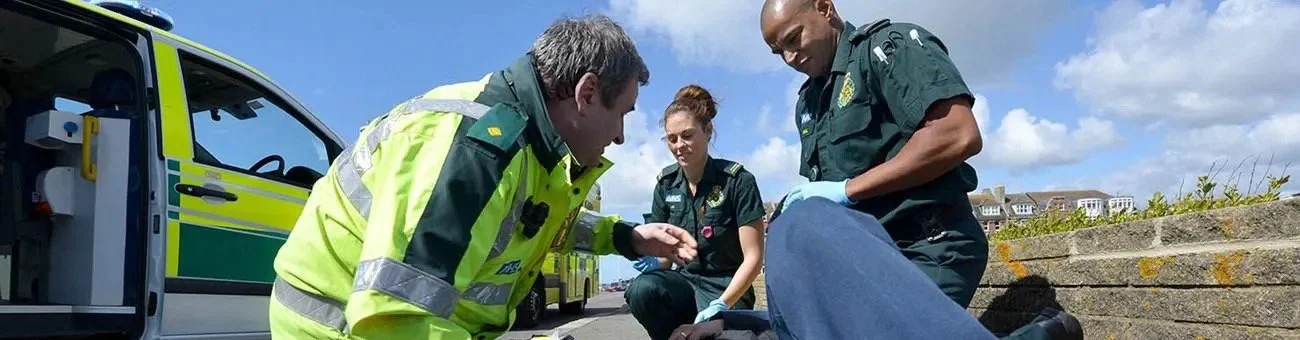
University of Brighton paramedic science students on placement with South East Coast Ambulance Service
What it is like to study paramedic science at Brighton
Current students describe a course built around real clinical experience from week one. Mia Collins said: "We are on the ambulance twice a week, so we get to experience our future job right now. My first day on placement I'll be honest I was really nervous, but once I was on base and had met my mentor, I felt a lot calmer. The paramedics on the road are genuinely so kind and have all been in your position so know how you feel."
Nick Worman added: "All of our lecturers used to be paramedics which adds to the teaching experience. You know you can ask them anything and they can give you specific examples to help with any questions. In the first few weeks we covered basic CPR, took ops, spent a week at SECAmb education centre and I had booked my first two ambulance shifts."
Chloe Lashmar said: "My ambulance placement was outstanding. It is real life and there are hurdles we must overcome each day, and only by overcoming these, learn for next time." Jason Roberts, a graduate, offered his tip: "Before you apply, get an understanding of what being a paramedic involves. Being aware of the high-paced environment with range of shift patterns and current demands working frontline for the NHS in the ambulance service is essential."
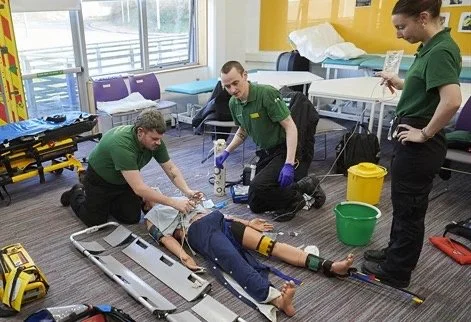
University of Brighton paramedic students during a simulation training session
About the Paramedic Science degree
The Paramedic Science BSc(Hons) is a three-year full-time degree based at the Falmer campus, approved by the Health and Care Professions Council (HCPC) and endorsed by the College of Paramedics. Around 50% of the course is spent on placement, primarily with South East Coast Ambulance Service NHS Foundation Trust, with additional placements in mental health, emergency departments, operating theatres, paediatrics and maternity.
The course team is led by Chris Matthews, an experienced advanced clinician and educationalist who continues to work part-time in clinical practice. The wider team includes Adam Davis, joint inter-professional lead with 16 years in the London ambulance service; Claire Fox-Wilson, transfusion practitioner and lecturer; James Hoyles, a Critical Care Paramedic with 13 years of frontline experience; and Rich Borrett, an advanced life support instructor and advanced clinical practitioner.
The course is ranked 7th in the UK for graduate prospects and 14th for student satisfaction (Complete University Guide 2027). 95% of graduates are in work or further study 15 months after graduating, with 100% of working graduates in highly skilled roles as health professionals, and graduates rank in the UK top 20% for earnings in sport and health sciences three years after graduating (Longitudinal Education Outcomes 2025).
Students also take part in Schwartz Rounds during placements, hour-long sessions where students come together to listen to stories and share reflections in a supportive and confidential environment. Progress is monitored through practical assessments using the university's Flexible Learning Environment, equipped with video cameras and microphones to record and replay responses to simulated emergency scenarios. Students can also track course updates through Student View.
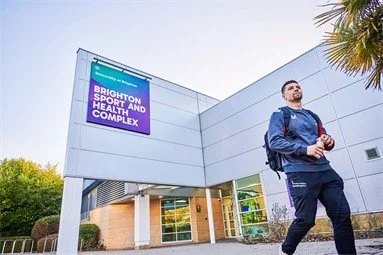
University of Brighton, home to the Paramedic Science BSc(Hons)
Facilities
Specialist facilities include a community flat fitted with cameras and microphones for realistic training scenarios, with an observation room for playback and debrief. The Clinical Skills and Simulation Suite is an invaluable tool for assessment and monitoring progress throughout the course, with an environment that simulates real-life professional experiences so students build confidence before going out on the road.
Fees and how to apply
UK students receive a non-repayable NHS learning support grant of at least £5,000 per year. Fees are £9,790 full-time for 2026/27. The course is full for 2026 entry. The next opportunity to start is September 2027. Apply through UCAS when the cycle opens.
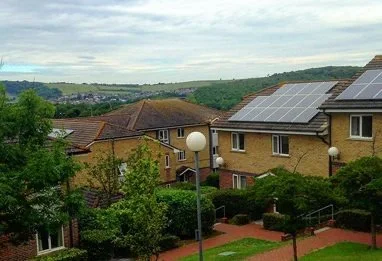
University of Brighton halls of residence at Falmer campus
Brighton: where you will be based
The Falmer campus sits on the edge of the South Downs, around four miles from Brighton city centre, next to the Amex stadium and Stanmer Park. The campus has two halls of residence on site, a library, restaurant, cafes, a fitness suite, swimming pool, sports pitches and a Clinical Skills and Simulation Suite used by health students. Falmer train station is right next to campus, a nine-minute journey to central Brighton.
Accommodation is guaranteed for all eligible first-year students. Almost all (98%) of students starting in 2025 got their first or second room choice. Options closest to Falmer include Paddock Field and Great Wilkins halls on campus, and Varley Park, a popular dedicated halls site around two miles from Falmer.
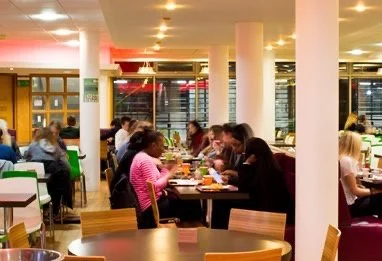
Students dining at Falmer campus, University of Brighton
Named one of Time Out's 50 best cities in the world in 2025, Brighton is described by the guide as having "all the important parts of a sprawling cosmopolitan metropolis, with the easy-breezy beachy attitude to life that makes you feel welcome in an instant." The city leads the way in arts, music, sustainability and creative technology, with a digital sector contributing over £1bn a year to the local economy. Annual highlights include the Brighton Festival, the Fringe, the Great Escape festival, Pride and the Brighton Marathon.
Many of the work-based learning opportunities offered on Brighton courses, such as placements and guest lectures, are provided by businesses and organisations based in the city. Students have found that living in Brighton enriches their learning experience, and even at the end of their course they are still finding new things to explore and inspire them.
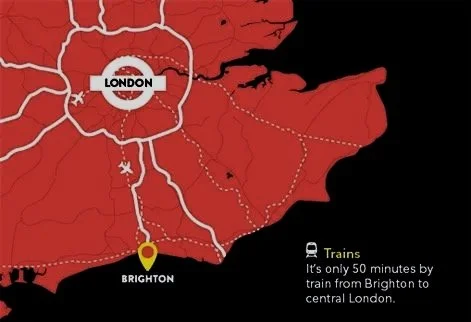
Brighton is just 50 minutes from central London by train
It is only 50 minutes by train from Brighton to central London, with daily direct trains to Bristol, Bedford, Cambridge, Gatwick Airport, Portsmouth and Southampton.
Need support now?
If you or someone you know is struggling, Samaritans is available free, 24 hours a day, 365 days a year.

Brighton, one of Time Out's 50 best cities in the world