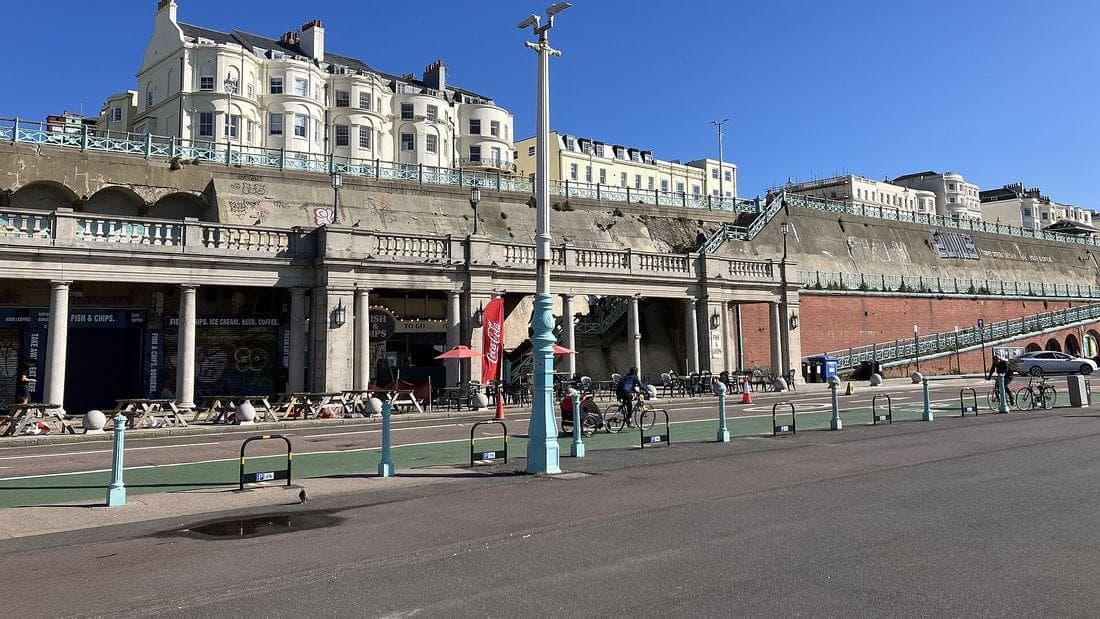
Brighton and Hove City Council has told ImJustBrighton that restored seafront ironwork is now coated in turquoise RAL 6027, which it says is the closest available match to the colour used on Madeira Terrace since the 1920s.
In a written reply on Monday 2 November 2026, the council said modern protective coatings, rather than gloss paint, are now specified for new cast iron and for ironwork blasted back to bare metal. It said the change was not driven by cost savings.
“While we welcome the savings this new technique will bring, our primary aim is not short-term cost reduction but the application of restoration techniques that better preserve and protect our historic infrastructure.”
Councillor Jacob Allen, Cabinet Member for Public Realm, in a statement to ImJustBrighton
Reports this autumn said the council had stopped using Brighton Blue on restored seafront ironwork. On 29 October ImJustBrighton put seven written questions to the council press office. The council replied on 2 November with written answers and a statement from Councillor Jacob Allen, Cabinet Member for Public Realm.
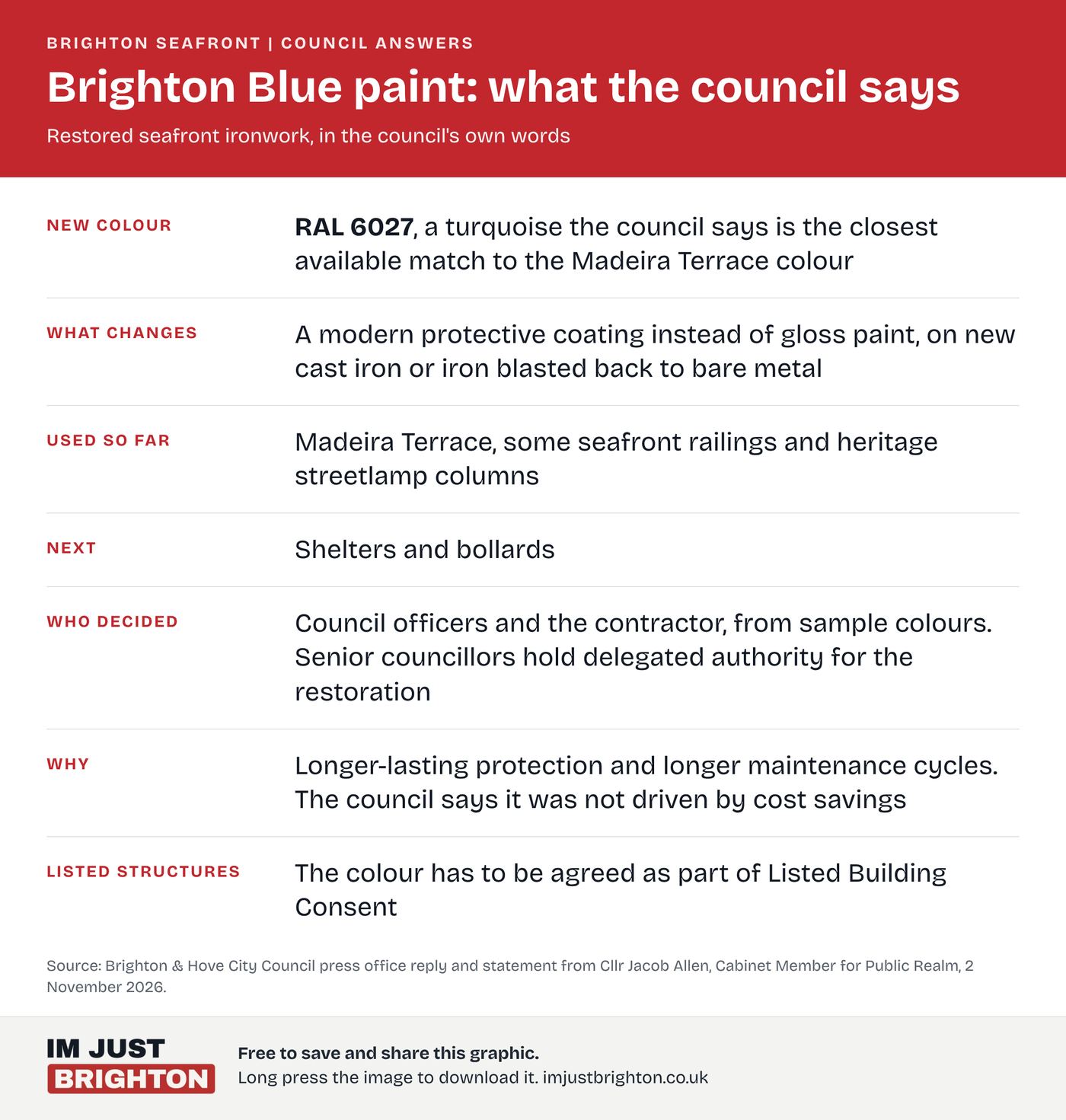
Our questions and the council's answers
1. What has changed, and when was the decision made?
The council told ImJustBrighton: “Modern protective coatings rather than gloss paint are now specified for new cast iron or where abrasive blasting has removed all previous paint and taken the surface back to the bare metal. These coatings often come in a limited colour palette or can only be mixed to a specific RAL code. The first time a RAL code was used was for the coating applied to the Madeira Terrace perimeter fencing in 2015.” It did not give a date for the decision.
2. Who made the decision: a committee, a cabinet member or officers?
“Brighton & Hove City Council officers and the contractor using a number of sample colours to find the best match, with senior councillors having delegated authority to proceed with restoration and refurbishment of cast iron assets on the seafront.”
3. What is the reason, and how much will it save?
The council said the change applies only to cast iron where a RAL colour is required and was not driven by cost savings, but by the long-term resilience of the coating compared with previous painting regimes. It gave no figure for any saving.
4. Which colour or paint system is now being used?
“RAL 6027.”
5. Which structures does it apply to, and have any been repainted?
“New and bare metal cast ironwork. So far, Madeira Terrace, some seafront railings and heritage streetlamp columns, but it will include shelters and bollards in future.”
6. Was heritage advice taken, and will Brighton Blue be used on the seafront in future?
“Respect for the area's heritage in such an iconic location was prevalent when procuring a shade of turquoise which closely matched Brighton Blue. Where buildings or structures are listed then the colour needs to be agreed as part of the Listed Building Consent.” The council did not say whether Brighton Blue paint itself will be used on the seafront in future.
7. A named quote from a councillor or council spokesperson.
Councillor Jacob Allen gave the statement below.
What RAL 6027 is
RAL is a colour-matching system widely used to specify paints and coatings. In the RAL Classic range, RAL 6027 is listed as light green, while the council describes the shade as turquoise. The council says the colour was chosen by testing a number of sample colours and by microscopic paint analysis of the turquoise used on Madeira Terrace since the 1920s.
The council also says the colour will look different after dark, because the terrace is getting a new lighting scheme, and that it will become more muted over time.
What Councillor Jacob Allen said
Councillor Jacob Allen, Cabinet Member for Public Realm, gave ImJustBrighton this statement in response to our questions:
“As we continue to restore our historic lamp columns, bollards, railings and, of course, the Madeira Terrace arches, serious care and attention is given to the heritage.”
“Our approach balances preserving these iconic cast iron structures with taking advantage of modern preparation methods and advanced protective coating systems to ensure they can be maintained in the future.”
“We’re protecting the cast ironwork using a specialist, cost effective and long-lasting coating system, rather than standard paint, and the closest available match to the turquoise paint used on the terrace since the 1920s, determined by microscopic paint analysis.”
“While we welcome the savings this new technique will bring, our primary aim is not short-term cost reduction but the application of restoration techniques that better preserve and protect our historic infrastructure.”
“The coatings will keep the cast iron in good condition for longer, extend maintenance cycles and reduce the frequency of future interventions. This is a more sustainable approach to maintenance and may generate savings over the longer term.”
“The use of the matched colour is specific to restoration projects, such as Madeira Terrace and the city’s seafront lamp columns, where durability and long-term maintenance are important considerations.”
“In daylight, it will very closely match the turquoise used on the terrace for the past 100 years, while the terrace’s new lighting scheme will create different visual effects after dark.”
“Over time the appearance of the colours will become more muted, but we are confident this is as good a match as possible.”
Councillor Jacob Allen, Cabinet Member for Public Realm, Brighton & Hove City Council
The council did not give a figure for any saving, and said any saving may come over the longer term.
Madeira Terrace: the ironwork behind the colour
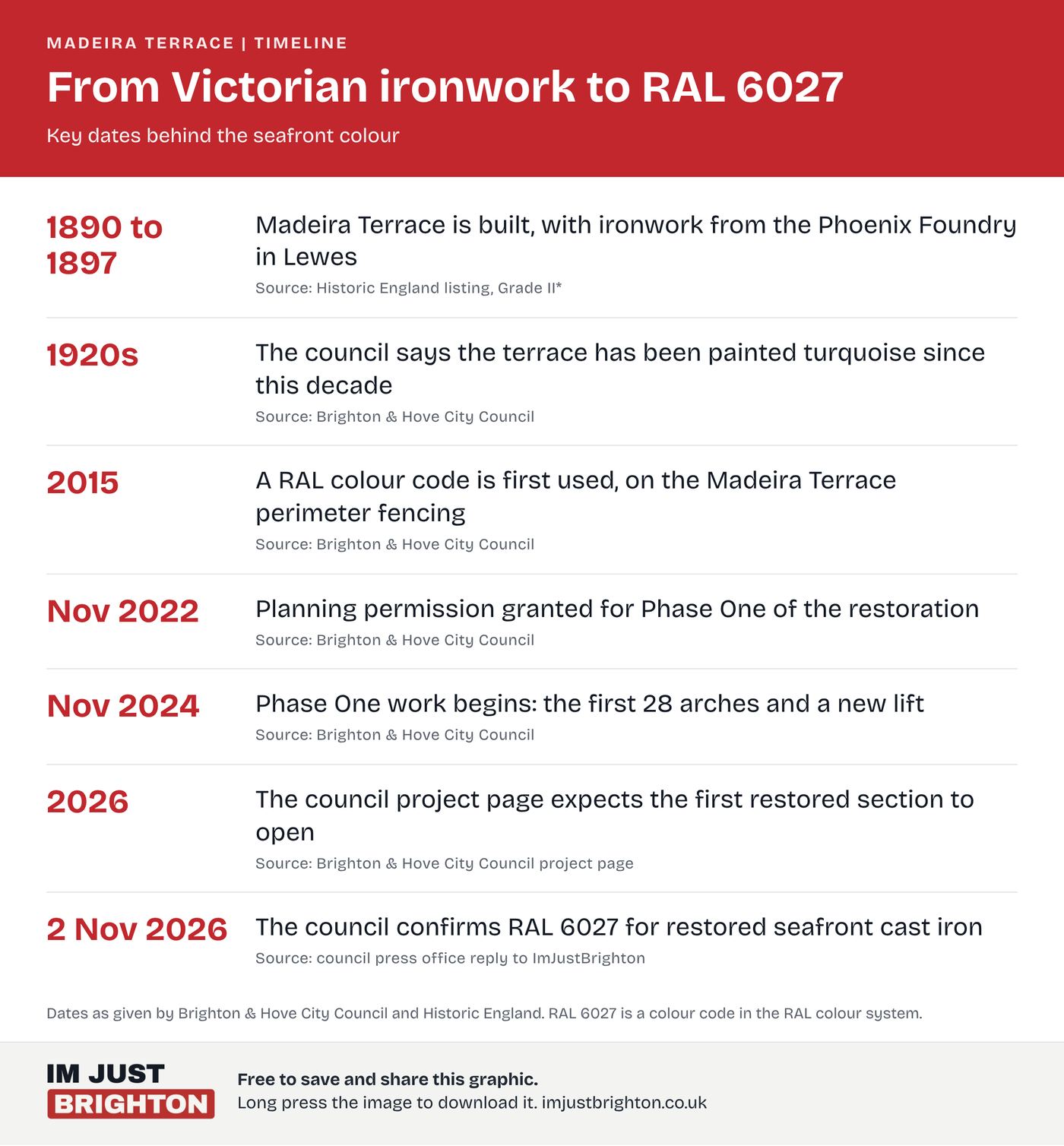
Madeira Terrace is a Grade II* listed structure, about 865 metres long, with 151 round-headed arches. According to its Historic England listing it was built between 1890 and 1897 and designed by Brighton Borough Surveyor Philip C Lockwood, with decorative ironwork made at the Phoenix Foundry in Lewes. The listing describes the structure as predominantly cast iron or wrought iron.
The terrace closed to the public between 2015 and 2016 because it was unsafe, and its restoration is being done in phases because of funding and scale. Phase One covers the first 28 arches and a new lift to the eastern seafront. Planning permission was granted in November 2022, JT Mackley & Co was appointed main works contractor in 2024 and work began in November 2024. The council's Madeira Terrace project page says it is anticipated that the first restored section will open in 2026.
How the council chose the new approach
In its 4 August 2026 news release on the Hove seafront railings, the council said its new specialist approach to refurbishing the cast iron railings was chosen following several trials of paint systems and preparation methods. It said the approach offers a longer-lasting finish than other methods, which is particularly beneficial in the most exposed seafront locations, such as sections of Hove seafront.
That work starts with a technique called garnet blasting, which the council describes as eco-friendly, to strip the railings back to bare metal before repainting. In our earlier report on the restoration of the seafront railings, contractors were stripping about 300 metres of cast iron railings west of the Meeting Place cafe on Hove seafront. The council says the new coating will also be used on shelters and bollards in future.
The council said in August that once the current phase is finished, it would like to hear from community groups interested in adopting a stretch of railing or a restored shelter to carry out minor paintwork maintenance. Eleven of the cucumber benches on Hove seafront were repainted in 2026 with help from volunteers.
What happens next
More structures. The council says the coating will be used on shelters and bollards in future.
Hove railings. In its August release the council said the first phase of its Hove seafront railings restoration would pause over autumn and winter, with phase 2 due to start in spring 2027.
Madeira Terrace. The council's project page says it is anticipated that the first restored section will open in 2026.
Brighton Blue paint: quick answers
What colour is the new seafront paint? RAL 6027, which the council describes as turquoise. RAL lists the code as light green.
Is Brighton Blue being scrapped? The council did not say that. It said the RAL 6027 coating is a close match to Brighton Blue and that the matched colour is specific to restoration projects, such as Madeira Terrace and the city's seafront lamp columns.
Why has the council changed the paint? It says modern protective coatings last longer than gloss paint on new or bare-metal cast iron and extend maintenance cycles.
Is it about saving money? The council says the change was not driven by cost savings. Councillor Jacob Allen said the council welcomes the savings the technique will bring and that it may generate savings over the longer term.
Who decided? Council officers and the contractor, with senior councillors holding delegated authority for the restoration.
Will the colour fade? Councillor Jacob Allen said the appearance of the colours will become more muted over time.
Where is it used? So far on Madeira Terrace, some seafront railings and heritage streetlamp columns, with shelters and bollards to follow, the council says.
Sources: Brighton & Hove City Council press office written reply of 2 November 2026; the council news release Restoring our iconic seafront railings (4 August 2026); the Historic England listing for Madeira Terrace; the council's Madeira Terrace project page.
Comments
No comments yet. Start the conversation.