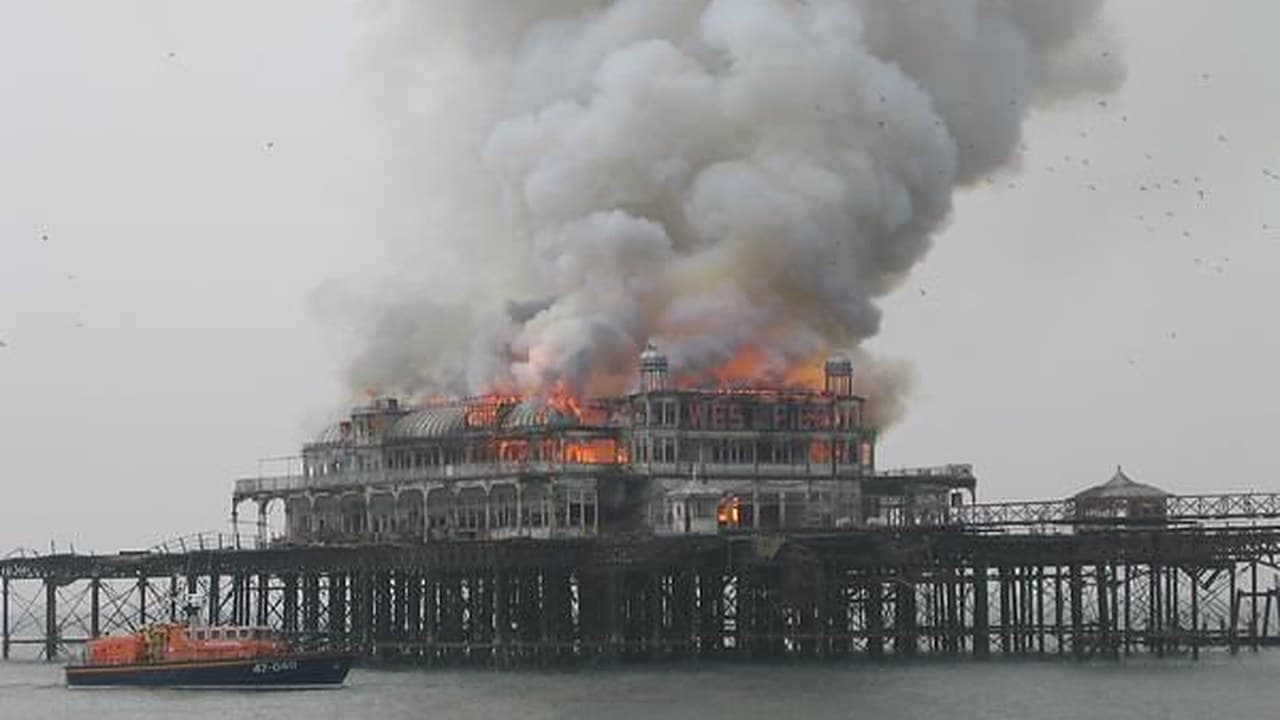
The West Pier opened in 1866, closed to the public in 1975 and has been falling into the sea ever since. More of it collapsed during Storm Austen on Friday 23 October 2026, and two days later a free online gallery of the pier went live: The Latest Damaged View of the Pier.
The gallery hangs 166 pictures of the pier, 117 made by people and the rest by AI, and asks visitors to work out which is which. Its curator emailed ImJustBrighton about it. Here are 33 of its human pictures, from a Victorian engraving to an aerial view from 2025, each set against what was happening to the pier at the time.
Can you spot the AI?
The pictures: The gallery’s About page says 117 of the 166 pictures on the wall are by people. Every one is openly licensed and credited, and was chosen from 1,874 candidate images found on Wikimedia Commons, Flickr and Geograph through Openverse.
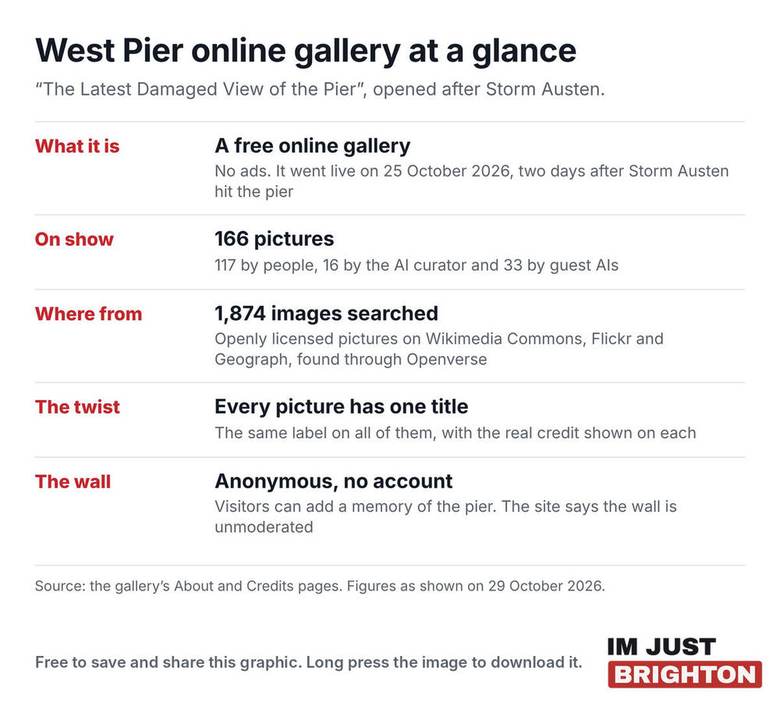
The AI pictures: Sixteen are by the AI curator, described as live generative pieces written in code. Another 33 are by what the site calls guest AIs, other models given the same brief. The site labels them and says the human works were not cropped, filtered or altered, only resized for the web.
The twist: Every picture is retitled “The latest damaged view of the pier”, with its real title and credit shown. The site’s statement says:
“Decide for yourself which half is the art.”
The Latest Damaged View of the Pier, gallery statement
The site has a ten-second test that shows two pictures, one by a person and one by a machine, and asks which is which. You can also filter the wall by human or AI.
ImJustBrighton note: The curator’s email describes pictures by “local artists and visitors”. The gallery’s own credits page lists openly licensed images found online.
1866: The West Pier opens
The West Pier opened in 1866. Engineer Eugenius Birch began building it in 1863, and the West Pier Trust’s chronology says it cost £27,000 and was 1,115 feet long. The Trust says the Mayor, Henry Martin, opened it.
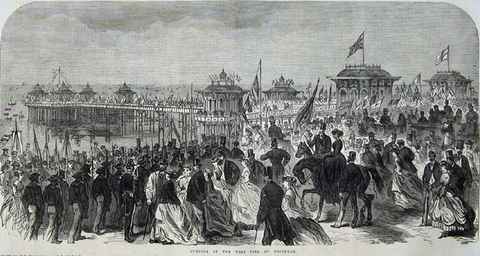
This engraving, titled Opening of West Pier 1866, shows a crowd with flags on the pier and its buildings behind. Historic England’s listing says the pier was built of cast and wrought iron, wood, glass and lead.
About 1870: Victorians on the deck
This oil painting looks out from the pier with people strolling on the deck and the Brighton seafront beyond. It is held by Brighton Museum and Art Gallery and credited to James Webb, but the file name on Wikimedia Commons credits George Earl, so the artist is not certain.
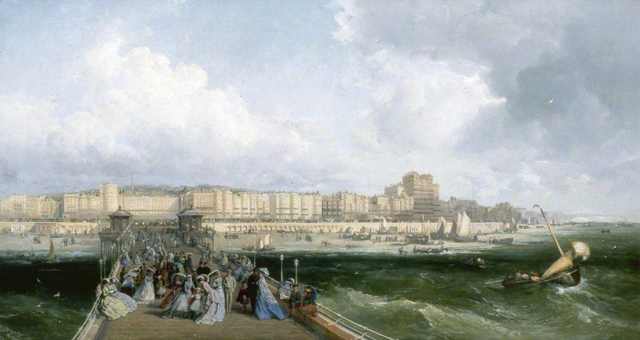
The pier was still new. The Trust’s chronology lists weather screens along its length and steamer landing stages among the additions of the 1880s.
1896 to 1900: Boats on the beach
This album photograph was taken between 1896 and 1900 and carries the French title Vue de la jetée ouest de Brighton. A large pavilion stands at the pier head, with small boats afloat and people standing in the shallows below.
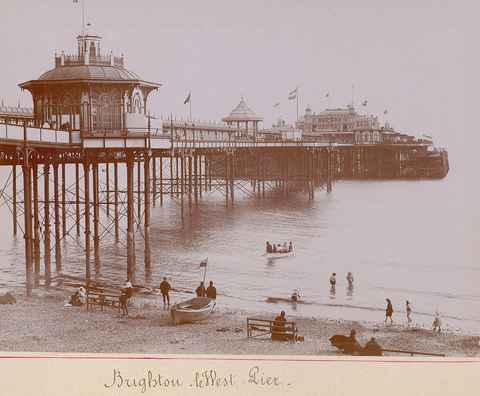
The pavilion went up in 1893, when the Trust says the pier head was widened for a concert hall seating 1,400. In August 1896 a storm destroyed the neighbouring Chain Pier, and the Trust says its wreckage damaged the West Pier.
About 1898: Carriages at the foot of the pier
Frith and Co. of Reigate printed the date 1898 on this view of the pier, which is in the Rijksmuseum’s collection. Horse-drawn carriages wait on the seafront beside the kiosk at the pier entrance.
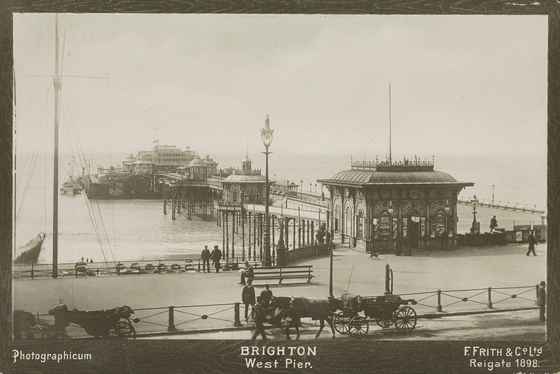
After the 1896 storm the Trust says a landing stage was built so that steamers could bring excursion passengers to the pier.
About 1900: The pier from above the beach
A sepia postcard from about 1900 looks along the shore at the West Pier from a high viewpoint. The long deck runs out to the pavilion at its head, and groups of people stand along the water’s edge.
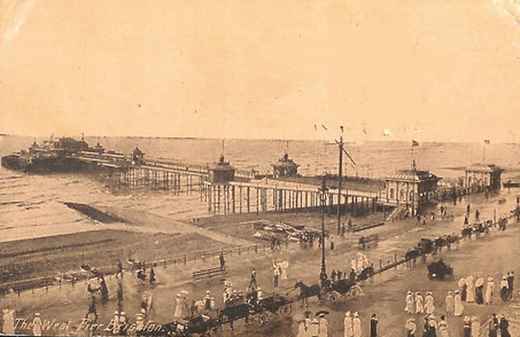
The pier stands on Kings Road opposite Regency Square. In 1916 the Trust says it was widened at the centre to make room for a new concert hall.
About 1900: A postcard sent home
Coloured postcards were the text messages of the Edwardian seaside. This one prints the title The West Pier, Brighton at the top, with a roofed kiosk on the deck and carriages and strollers around it.
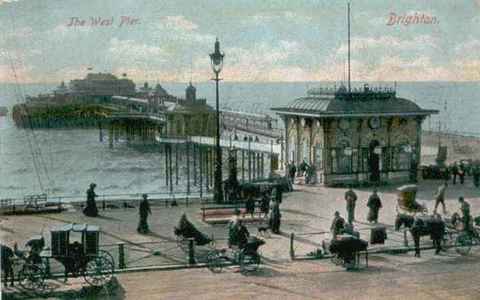
Historic England’s listing records octagonal kiosks at the north end of the pier’s theatre.
Undated: Crowds on the deck
The card behind this view, titled Brighton from the West Pier, carries no date. It looks back along the deck towards the town, with a covered walkway down the middle, flags flying and crowds on both sides.
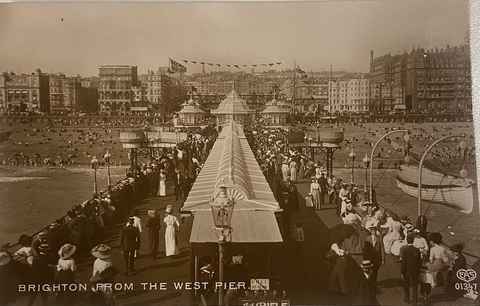
We cannot date it, but it shows what the pier was for: promenading, music and company. The Trust says a central bandstand was added in 1875.
19 October 1903: A postcard swap
The message on this card is dated 19 October 1903. The sender says they saw the recipient’s name on an exchange list, are forwarding this card and would like to swap more.
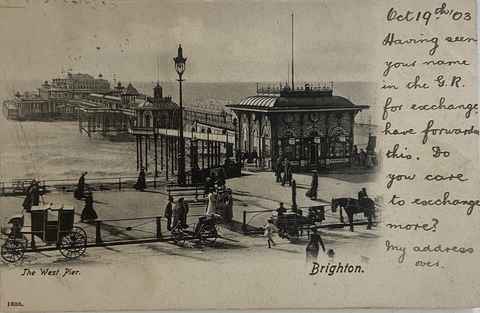
Collecting and swapping postcards was a popular hobby, and views of the pier travelled widely. In 1903 the Trust says the pier head pavilion was converted into a theatre seating 1,000.
Before 1906: The Kings Road promenade
E. T. Tuffin of 50 Kings Road published this view of the seafront promenade, dated before 1906 on Wikimedia Commons. Crowds in long skirts, suits and hats walk and sit along the railings, with grand seafront buildings behind.
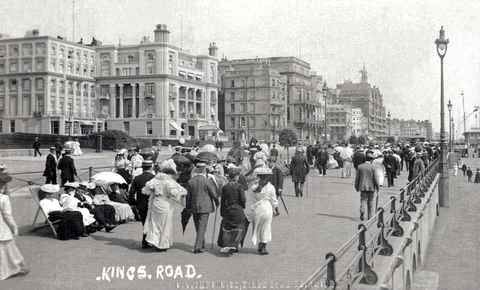
The photograph is of the promenade, not the pier, but it shows the crowds the pier was built to draw. The West Pier is on this same seafront road.
1908: Professor Doughty’s performing dogs
A postcard posted on Flickr by mark’s vintage topographical postcards is captioned 1908 Professor Doughty’s Performing Dogs, West Pier Brighton. A man in a hat stands beside dogs balanced on large balls on the deck, with onlookers and parasols behind.
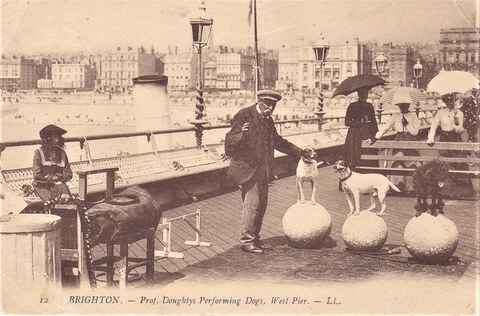
Variety acts like this were the pier’s business. By 1908 its pavilion had been a concert hall for 15 years and a theatre for five.
1916 to 1975: Concert hall, war and closure
1916. The Trust says a new concert hall was built and the pier widened at the centre, completing half a century of building.
1919. The Trust’s chronology records the highest attendance in the pier’s history, 2,074,000 paying visitors.
1943. Royal Engineers cleared anti-personnel devices from the pier ahead of D-Day. The Trust says two soldiers were seriously injured and the blasts destroyed a kiosk, later replaced by a helter skelter.
1968. The pier was a filming location for Richard Attenborough’s Oh! What a Lovely War, according to the Trust.
1969. Historic England says the pier was first listed on 9 October 1969, and it is now Grade I listed.
1975. The whole pier was closed to the public for safety reasons, the Trust says. Eight years later, in 1983, the Crown Estate Commissioners sold it to the West Pier Trust for £100.
17 August 1990: The domed kiosk
Christopher Hilton photographed this ornate domed kiosk on 17 August 1990 in a close-up later added to Geograph. By then the pier had been closed to the public for 15 years.
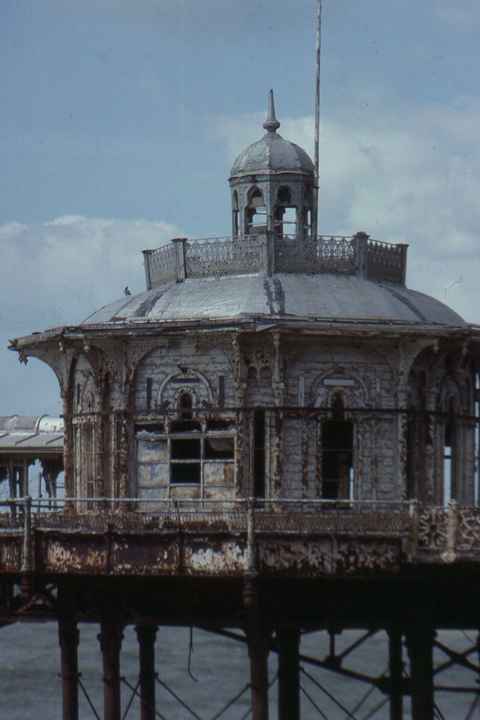
Historic England’s listing says the 1987 hurricane badly damaged the pier, and that in 1991 the causeway from Kings Road and a concert hall kiosk were demolished.
Before the fires: The pavilion with its name on the roof
This undated picture shows a large domed building on the pier with the name WEST PIER in red letters across its roof. It was taken before the fires of 2003, because that is when the pier’s buildings burned.
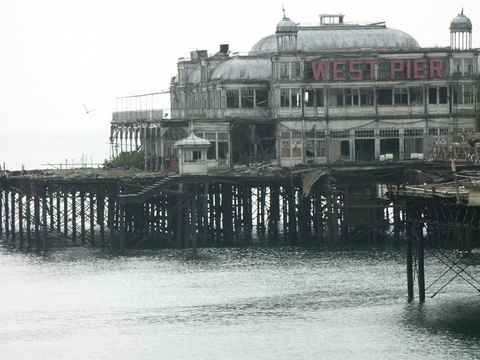
In 1998 the Trust says the Heritage Lottery Fund approved £14.2 million for restoration. In 2002, once a European Commission challenge was cleared, the fund reactivated the project and a £1.2 million design phase began.
1 May 2002: Still standing
Les Chatfield photographed the pier from the beach on 1 May 2002. A gangway slopes from the shingle to a domed kiosk, with the sea beyond.
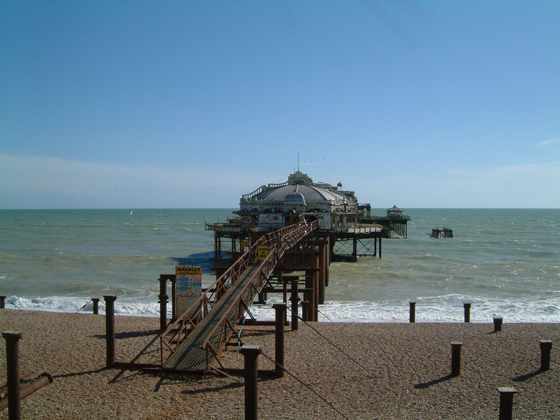
Eight months later a winter storm brought down part of the structure. The Trust says the concert hall in the middle partially collapsed on 29 December 2002 and again on 20 January 2003.
3 March 2003: The fallen concert hall
Briantist photographed the concert hall lying on its side in mist on 3 March 2003, with broken timbers in the foreground.
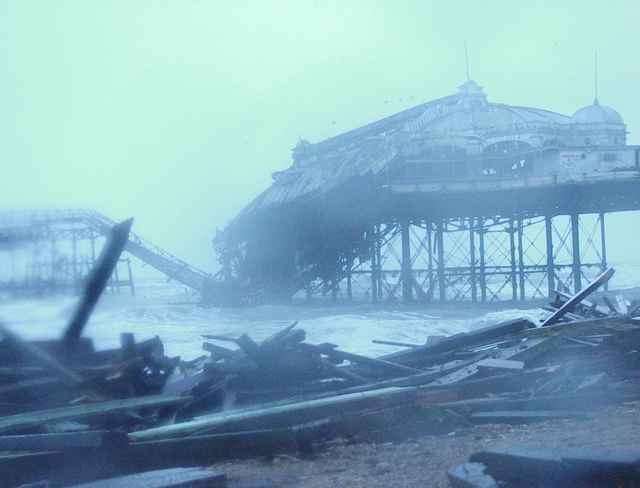
Days earlier, on 26 February, the Trust says Brighton and Hove City Council had granted planning permission for the enabling development, the new building intended to help pay for repairs. The restoration was due to start that March.
28 March 2003: The fire
Mark Harris photographed the pier head pavilion on fire on 28 March 2003. Smoke rises over the burning building while an orange lifeboat sits in the foreground.
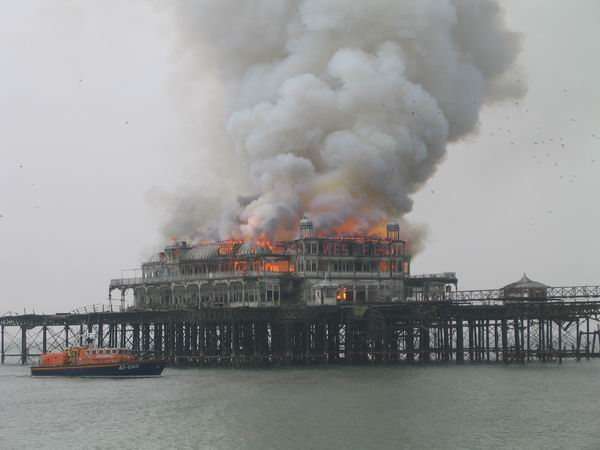
The Trust describes the fires of 2003 as arson attacks and says they destroyed the pavilion and the concert hall weeks before restoration was due to start. A second fire followed in May.
11 April 2005: Waves at the ruin
Kevin Walsh photographed a wave breaking on the beach with the broken pier behind it on 11 April 2005.
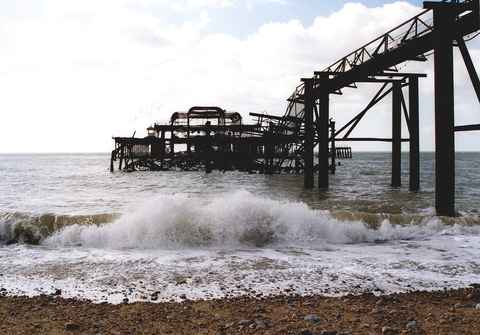
The hope of restoring the pier had gone by then. The Trust says the Heritage Lottery Fund withdrew its funding in 2004. Four months after this picture, on 17 August 2005, the architects Marks Barfield proposed building the i360 observation tower at the root of the pier.
10 April 2006: Keep away
A red warning sign on a post on the beach reads Underwater Hazards Keep Away, with the pier ruin behind it, in a photograph by Les Chatfield dated 10 April 2006.
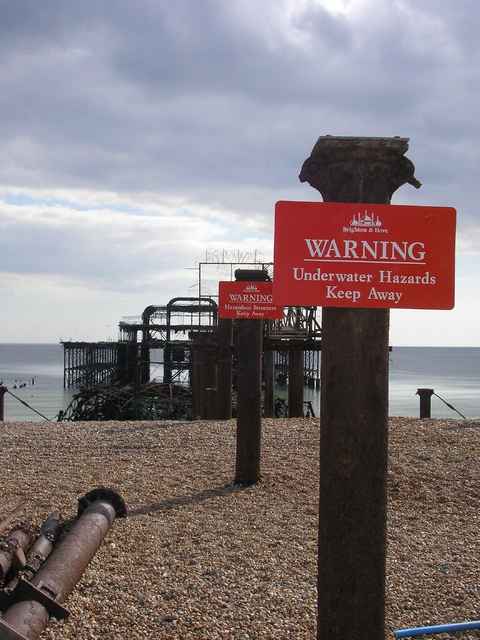
The warning still applies. After Storm Austen the Trust said the ruin is too dangerous and too costly to stabilise. Read our report on what the Trust says.
5 June 2006: The iron frame
Les Chatfield’s picture from 5 June 2006 shows a tall rusted frame standing on iron legs in the water, with thin wires across the top.
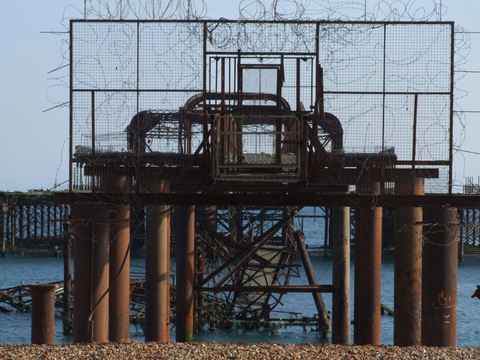
Historic England’s listing says the pier was built of cast-iron columns carrying beams and girders, braced with diagonal ironwork. That iron is what survives.
21 July 2006: Gulls on the ballroom roof
Les Chatfield photographed seagulls perched on a mass of rusted ironwork rising from the sea on 21 July 2006. He titled it Brighton West Pier 20060721 ballroom roof.
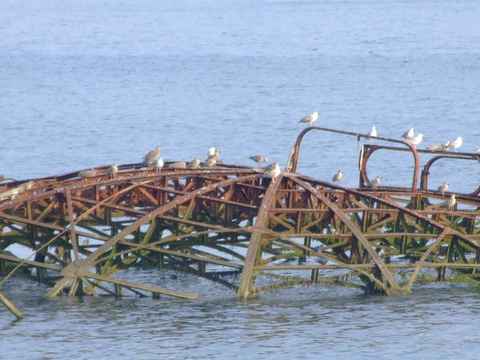
The title calls it a ballroom roof, and we cannot confirm which building it came from.
21 July 2006: Arches on the promenade
Taken the same day, this close-up of rusted arched ironwork is titled promenade.
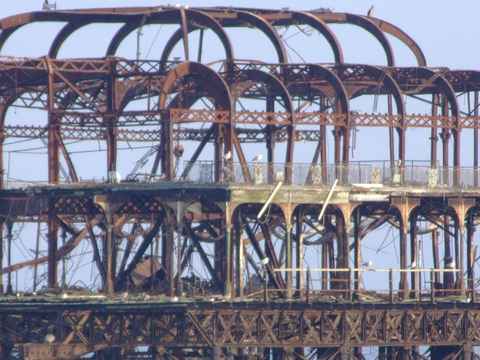
Three weeks later, on 10 August 2006, the Trust’s chronology records planning permission for the i360, the tower proposed for the root of the pier a year earlier.
10 December 2006: A last portrait
Les Chatfield titled this December 2006 picture a last portrait. A slipway runs into the sea with the pier head frame on the left and a low heap of wreckage on the right.
Two months earlier, on 11 October 2006, the Trust’s chronology records unanimous approval for the i360. The ruin stayed in the sea while the plans for the tower went ahead.
22 August 2007: Grey sea, grey wreck
Gürkan Sengün took this picture on 22 August 2007, in a set labelled London 2007 Brighton. A low mound of twisted ironwork lies in grey water.
By then the pier had been in ruins for years. According to Wikipedia, the middle of the pier collapsed in high winds in June 2004 and English Heritage declared it beyond repair a month later.
13 July 2008: Turquoise water
Schnittwerk photographed the ruin from the beach on 13 July 2008, with bright turquoise water, rusted iron legs and a red warning sign at the edge of the picture.
The pier no longer joins the shore. Historic England’s listing says the causeway from Kings Road was demolished in 1991, so the ruin stands out in the water.
28 October 2008: Nowhere gate
Les Chatfield called this picture nowhere gate. A tall rusted frame stands against a deep blue sky with a loose net of wire across its top.
It is the last of seven photographs by Les Chatfield in this article, taken on six days between 2002 and 2008.
17 June 2009: The ruin from the shingle
Wee Bugger took this picture on 17 June 2009 for Panoramio, and it is now on Wikimedia Commons. The pier head frame stands in calm water with a low heap of wreckage in front.
The pier is owned by the West Pier Trust, a charity formed in 1978. The Trust’s chronology says it bought the pier from the Crown Estate Commissioners for £100 in 1983.
25 October 2009: Silhouette on the water
Mary Carson photographed the ruin as a dark silhouette on sparkling water on 25 October 2009.
Further east the Palace Pier, which opened in 1899, carried on as Brighton’s working pier while the West Pier stood in the sea.
6 February 2010: A wreath for the pier
Julian Osley photographed a wreath of flowers with two notes attached to a fence on the beach on 6 February 2010, with the pier ruin in the distance. He titled it RIP West Pier Brighton.
The picture was taken five days before the lasers lit the ruin. The tower planned for the pier’s root took longer: building the i360 began in 2014 and the Trust gives 4 August 2016 as its public opening.
February 2010: Green lasers light up the West Pier
For one night in February 2010 the ruin glowed green. Lasers fanned out above the pier head and drew its outline in light over the dark sea, while people watched from the shingle.
The West Pier Trust says the display was sponsored by Tiger Beer as one of several public art installations across the country marking the Chinese New Year of the Tiger, and that it was designed by Laurent Louyet of Creatmosphere. This picture is dated 11 February 2010 on Wikimedia Commons, and the Chinese New Year fell on 14 February that year.
The Trust says it looked at ways of keeping the lights permanently but found it “prohibitively expensive”. Read the Trust’s own page, Pier Illuminated.
Undated: Moss, timber and iron
This black and white picture by Hachimaki, on Flickr, carries no date. Weed-covered legs and fallen timbers stand in the shallows with the pier frame behind.
Storms have done most of the damage since. According to Wikipedia, the pier split in two in February 2014, another section collapsed in February 2016 and the southwest corner fell during Storm Claudio in November 2022. Read our before and after photos of Storm Austen.
Undated: A red sky over the ruin
Neilhooting’s undated Flickr picture shows the pier frame black against a deep red sky, with its reflection in the wet sand.
The Trust’s West Pier Centre opened in a renovated arch on West Pier Piazza on 16 February 2017.
Undated: Farewell sunset
Elsie esq. titled this Flickr picture West Pier farwell. An orange sun sinks behind the pier’s broken legs while a flock of birds wheels over the water.
The flock may be starlings, which the Trust’s notes on starlings say roost over the pier in winter, gathering in large groups in the late afternoon and flying in to roost at dusk.
1 November 2017: Starlings at dusk
NormanofOxfordshire photographed a murmuration of starlings over the pier ruin at dusk on 1 November 2017.
The Trust’s starling page says flocks could swell to about 40,000 birds at the December peak, and that today they appear only occasionally in winter and in far smaller numbers.
February 2025: The ruin from the air
Janetotolau’s untitled aerial picture, dated 21 February 2025, shows the pier head frame in turquoise water with a small boat nearby and the Brighton seafront behind.
The ruin is smaller now. More of it fell into the sea during Storm Austen on Friday 23 October 2026, according to the West Pier Trust.
Add your memory of the pier
Visitors to the gallery can add a line or two about the pier on an open wall, with no account needed, and read what others have written. The site says the wall is anonymous and unmoderated on purpose, so read it with that in mind.
You can add a memory, take the spot-the-human test, or read the full credits and licences.
Comments
No comments yet. Start the conversation.